Tile · · 7 min read
Glass vs Porcelain Pool Tile: Standards, Heat and Cost
Glass vs porcelain pool tile: porcelain absorbs 0.5% water or less, glass must pass a 100°F thermal shock test, and glass costs $8 to $50 per square foot.
By Outdoor Hardscapes Pool Finishes, pool finishing contractor in Pensacola, FL.
Both glass and porcelain work on a pool waterline when they are made for submerged use; they differ in how they are tested, how they are set and what they cost. Under ANSI A137.1, porcelain is ceramic tile with a water absorption of 0.5% or less, measured with the ASTM C373 test, according to the Tile Council of North America (TCNA). Glass tile follows its own standard, ANSI A137.2, which requires glass for wet and outdoor use to pass a thermal shock test across a 100°F temperature range. On price, national cost guide HomeGuide (January 2026) lists porcelain at $2 to $25 per square foot and glass at $8 to $50, tile only.
We install both on pools in Pensacola and along the Gulf Coast: 6x6 porcelain, and glass mosaic in 1x1 and 1x2 formats. This guide explains how they compare so you can choose with the facts in front of you.
Is there a difference between pool tile and regular tile?
Yes. A pool tile spends its life half under treated water and half in the sun, and it has to stay bonded through both. Four things separate pool tile from tile made for a kitchen wall.
- Water absorption. LATICRETE, a maker of tile setting materials, says pools should use only impervious tile (under 0.5% absorption) or vitreous tile (under 3.0%), because tile that absorbs more than 3% can permanently expand from moisture. Porcelain meets the impervious level by definition.
- Mounting. Mosaics come on sheets. LATICRETE recommends paper face-mounted mosaics in pools and warns that back-mounted sheets held by PVC dots or glued mesh can end up with very low bond strength once saturated with pool water. ANSI A137.2 also recommends face mounting for submerged glass, according to TCNA.
- Slip resistance. Since July 2022, the ANSI tile standards (A137.1 for ceramic, A137.2 for glass and A137.3 for gauged porcelain panels) require manufacturers to report a product use classification, TCNA explains. Level interior floors walked on when wet need a wet DCOF of 0.42 or more; for exterior wet areas the rating is declared by the manufacturer. For steps, ledges and sun shelves, ask for that exterior wet classification.
- Setting materials. In a 2014 white paper, Custom Building Products recommends a high-performance mortar meeting ANSI A118.15 for submerged ceramic tile, and a mortar formulated for glass that meets the bonding mortar requirements of ANSI A137.2 when glass is used.
A “6x6 pool tile” simply means a tile 6 inches by 6 inches. One course of it fills a 6-inch waterline band.
How do glass and porcelain pool tile compare?
| Property | Porcelain | Glass |
|---|---|---|
| Product standard | ANSI A137.1 (ceramic tile) | ANSI A137.2 (glass tile) |
| Water absorption | 0.5% or less, by definition (ASTM C373) | Glass body; the standard focuses on thermal shock and strength |
| Thermal shock test | Not part of the porcelain definition | Must pass a test over a 100°F range for wet and outdoor use |
| Tile-only cost per sq ft (HomeGuide, Jan. 2026) | $2 to $25 | $8 to $50 |
| Formats we install | 6x6 | 1x1 and 1x2 mosaic |
| Pieces per linear foot of a 6-inch band* | 2 | 36 (1x2) to 72 (1x1) |
| Mounting for submerged use | Individual tiles | Face-mounted sheets recommended |
| Setting mortar (Custom Building Products) | High-performance mortar such as ANSI A118.15 | Mortar formulated for glass, meeting A137.2 bonding requirements |
| How HomeGuide rates it | Budget friendly, durable, many colors | Expensive, less durable, luxurious look |
*Nominal tile size, grout joints not counted.
The piece count explains a lot of the price and the look. A 6x6 band has few joints, so it reads as a clean line and has less grout to keep up. A 1x1 glass band has dozens of joints per foot, which gives it texture and lets it wrap tight curves, but it takes more time to set.
Is glass tile good for pools?
Yes, when the glass is rated for pools and installed with a system built for it. TCNA explains that ANSI A137.2 covers three kinds of glass tile (cast, fused and low temperature-coated) and tests strength differently by size, using modulus of rupture, triangular point load or compressive strength. It also notes that, unlike ceramic, not all glass tile on the market can handle outdoor temperature swings, which is why the thermal shock test exists.
Glass is the more demanding of the two to set. Custom Building Products points out that the coefficient of thermal expansion of glass is quite different from ceramic tile, so glass is more likely to crack from thermal shock outdoors. Their advice is to confirm that the tile meets ANSI A137.2, that the manufacturer recommends it for pools, and to use a mortar made for glass.
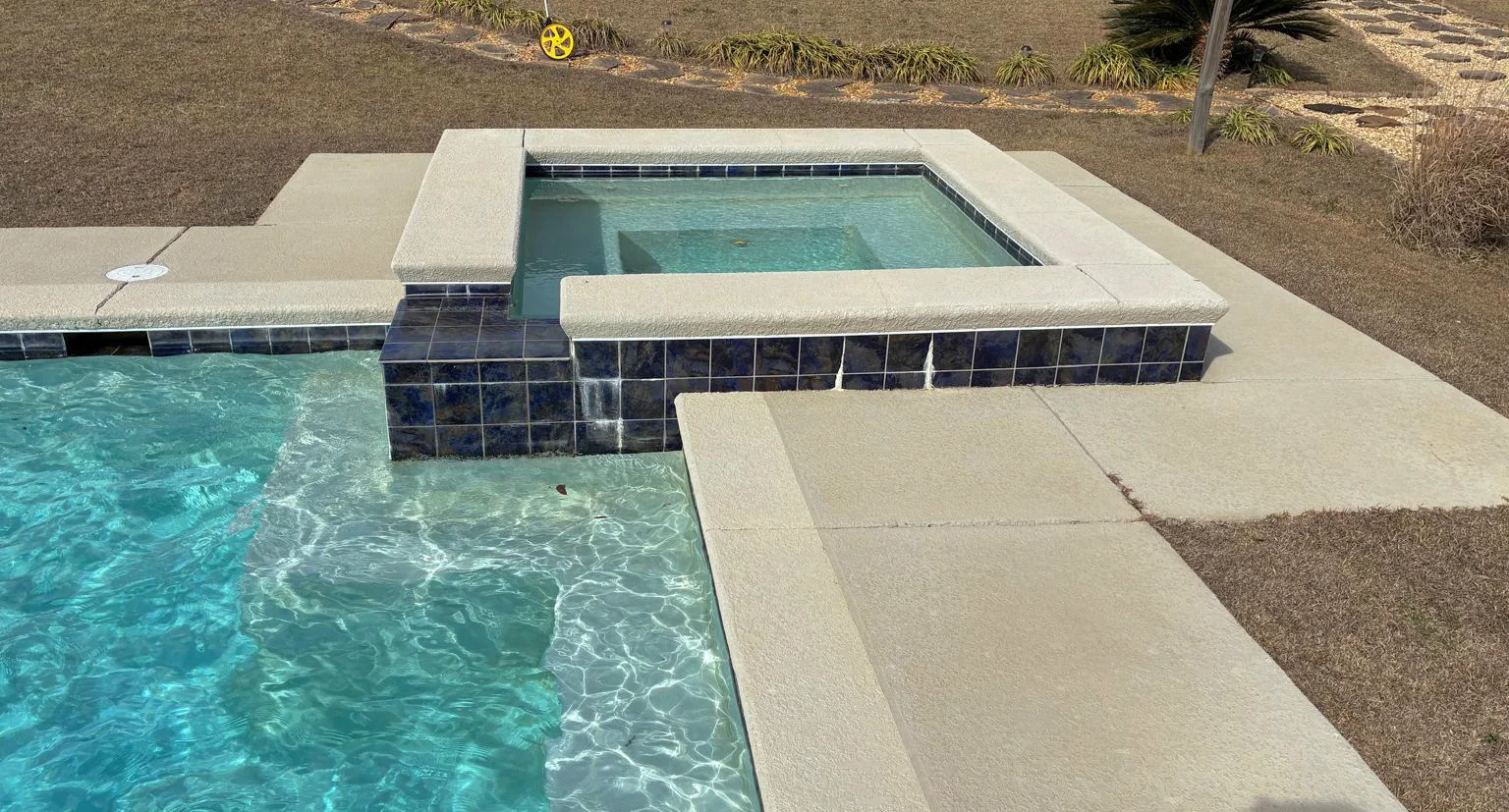
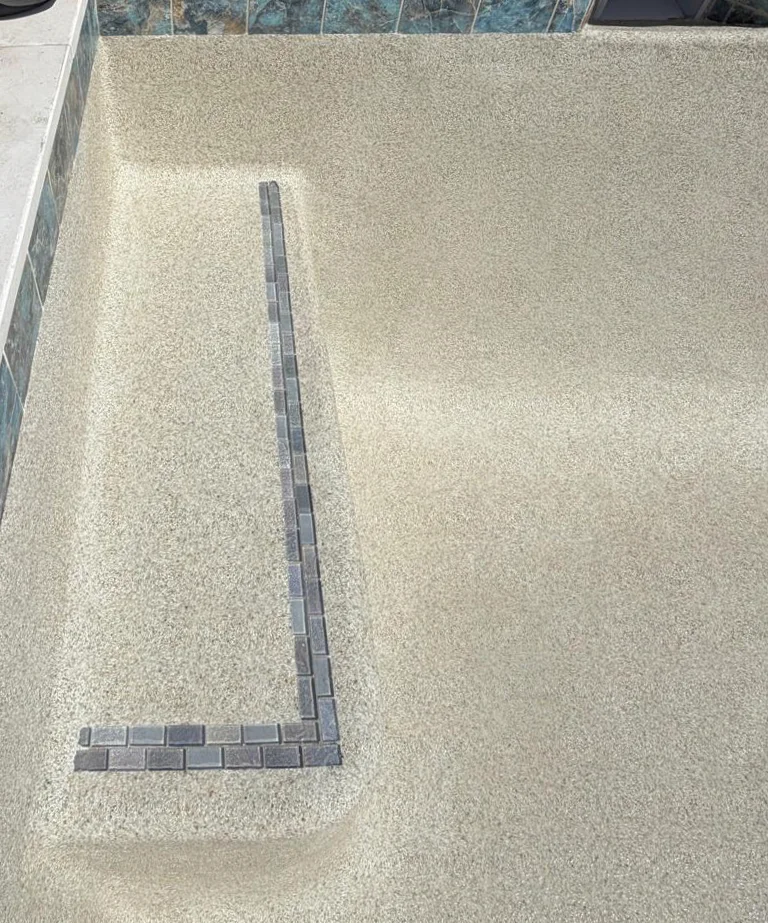
The payoff is the look. HomeGuide credits glass with brilliant colors and light-reflecting properties and calls it a fit for accent areas: a spa wall, a spillway, step edges or a strip inlaid in a ledge like the one in the photo above. You can also mix the two, running porcelain on the long walls and glass where people look closest. For more combinations, see our waterline tile ideas.
Does glass pool tile get hot?
The published guidance is about thermal shock, not surface temperature. In its 2014 white paper, Custom Building Products advises that exposed glass tile that may be heated by sunlight should, where possible, be protected from splashes of cool water, because that sudden change is what causes thermal shock cracks. The concern applies to glass that sits above the water: the strip above the waterline, raised spa walls, and glass set on a ledge or sun shelf. We did not find a published measurement comparing how hot glass and porcelain pool tile get in the sun, so treat any claim that one is hotter underfoot with caution.
Color is the other choice people make with heat in mind. Pebble Technology International told Luxury Pools magazine in 2022 that in hot markets such as Florida, Texas and Las Vegas, homeowners prefer cooler, lighter colors.
Which pool tile lasts longest?
Both last a long time when they are bonded well, though cost guides disagree on the number. HomeAdvisor (June 2026) says most pool tiles hold up for 10 to 20 years and top-tier ceramic or porcelain can last for decades with good cleaning and water chemistry, while Angi (September 2026) gives 5 to 10 years, depending on maintenance. HomeGuide calls porcelain and ceramic the best overall choice for most pool owners, noting that they withstand years of chlorine, UV and temperature swings without fading or cracking.
The guidance from setting material makers points at the grout and the mortar behind the tile more than at the tile itself. Custom Building Products’ 2014 white paper explains that soft water pulls calcium out of grout, mortar and the plaster underlayment, and that over time the grout can disappear and tiles come loose. For tiled pools it recommends keeping calcium hardness between 250 and 400 ppm, pH between 7.2 and 7.8 and total alkalinity between 80 and 120 ppm. Those ranges are written to protect the tile assembly; the interior finish of a plaster, quartz or pebble pool has its own published range, which your pool professional can check against. The opposite problem, white calcium scale on the band, is covered in our guide to removing calcium from pool tile. If your band is already cracked or loose, read about replacing pool tile before you choose new material.
How do you choose between glass and porcelain?
Start with how the pool is used and where the sun hits, then budget and look:
- Budget and length of band. On a long perimeter, porcelain’s lower tile cost adds up. HomeGuide’s ranges put glass at up to twice the top porcelain price per square foot.
- Look. Porcelain gives a crisp, classic band. Glass gives shimmer and depth of color.
- Shape. Tight curves and freeform pools suit small mosaics, which bend with the wall.
- Sun exposure. Glass that sits above the water in full sun is the part exposed to thermal shock, so plan where it goes with your installer.
- Mix. A porcelain band with glass accents on the spa, steps or ledges is a middle path.
Whatever you choose, the setting system matters as much as the tile: pool-rated mortar, the right mounting, cure time before the pool is filled, and balanced water afterward. Our pool tile page covers the porcelain and glass waterline tile we install. When tile is part of a larger update with new coping or a new interior finish, it fits into a full pool renovation so the edge lines up. We bring samples of both to the site, and the real price depends on the size of the pool, the tile and the condition of the wall, which we confirm on a site visit with a written estimate.
If you are in Pensacola, Alabama or the Mississippi Gulf Coast and want a second opinion on your pool, request an estimate.
Sources
- Porcelain in the Ceramic Tile Industry, Tile Council of North America, accessed November 25, 2026.
- Introducing ANSI A137.2, The New Standard for Glass Tile, Tile Council of North America, accessed November 25, 2026.
- Tile Initiative 2025, Tile Council of North America, accessed November 25, 2026.
- How Much Does Pool Tile Cost?, HomeGuide, accessed November 25, 2026.
- How Much Does Installing Pool Tile Cost?, HomeAdvisor, accessed November 25, 2026.
- Installation of Ceramic Tile in Swimming Pools, TDS 192, LATICRETE, accessed November 25, 2026.
- Installing Tile in Pools and Fountains, Custom Building Products, accessed November 25, 2026.
- Using Color to Make a Poolscape Pop, Luxury Pools Magazine, accessed November 25, 2026.