

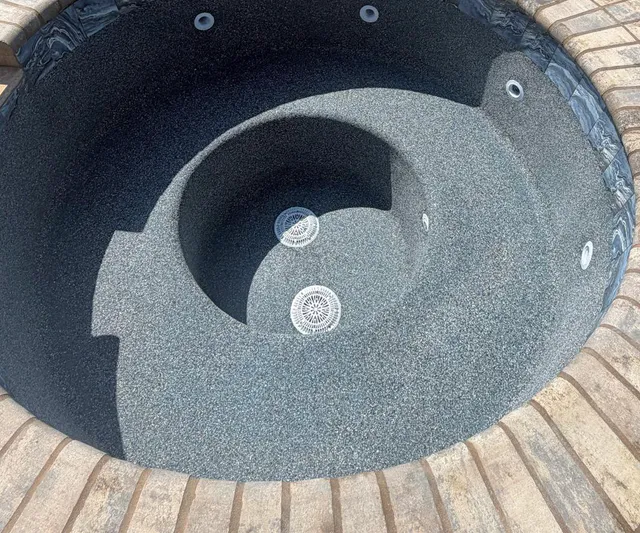
What is a pebble pool finish?
A pebble finish is a cement-based pool interior with small pebbles embedded in it and exposed at the surface. The National Plasterers Council (NPC) describes exposed pebble finishes as a natural stone look with a more textured surface than smooth plaster and a higher initial cost. NPT says its StoneScapes system combines naturally occurring quartz pebble, specialty aggregates, pigment and white Portland cement. We are a StoneScapes applicator and also work with other finish brands. This page is about the pebble material. If you are replacing a worn finish, our pool resurfacing page covers the process on an existing pool.
Regular Pebble, Mini Pebble or Mini Pebble with glass: what is the difference?
The three finishes we apply share the same idea and differ in stone size and in what is mixed with the stone. The descriptions below come from NPT's guide to its StoneScapes line, and the color counts from NPT's online catalog as of November 25, 2026 (series Regular Pebbles, Mini Pebbles and Touch of Glass).
| Finish | Stone size and look | Feel | Colors in NPT's catalog |
|---|---|---|---|
| Regular Pebble | The biggest pebble NPT offers and NPT's original finish, with a river-bottom look | The pebbles are smooth but can be felt by hand or foot | 13 |
| Mini Pebble | Smaller than Regular and larger than Micro; NPT says Mini has been the most popular pebble size for over 15 years | Not rated separately by NPT; in size it sits between Regular and Micro, which NPT calls its smoothest pebble | 17 |
| Mini Pebble with glass | Mini Pebble with colored glass beads added; StoneScapes calls its glass bead enhancement Touch of Glass, added in 1, 2 or 3 bag formulas | Like Mini Pebble, with glass in the mix | 9 |
The glass beads add color, contrast and shine to the water, and the number of bags sets how strong the effect is. For a closer look at the most requested option, read our guide to StoneScapes Mini Pebble.
How is a pebble finish applied?
Manufacturers describe the same basic sequence. Pebble Technology, for example, lists mixing the stone blend with cement, water and pigment, spraying it onto the pool, hand troweling it to compact the surface, then spraying or wiping it with water to expose the pebbles and remove excess cement. After a hardening period, the surface is washed and detailed with an acid solution to remove the cement film. The work is done on a dry, prepared shell, and the pool is then filled without stopping, which the NPC says helps prevent a bowl ring and shrinkage cracking. We apply pebble finishes on new pools for builders and, after surface preparation, on existing pools.
Is a pebble finish rough on your feet?
It has more texture than plaster, and that is the trade. NPT describes its Regular pebbles as smooth but noticeable against a hand or foot. HomeGuide notes that pebble finishes use smooth, rounded pebbles that are less uncomfortable to walk on than other aggregates. Mini Pebble uses smaller stones than Regular, according to NPT. If the smoothest possible surface matters most, compare our quartz pool plaster before deciding. We bring samples so you can feel the texture as well as see the color.
How long does a pebble finish last?
HomeGuide's 2025 cost guide puts a pebble finish at 15 to 20 years or more, against 7 to 12 years for standard plaster and 10 to 15 years for quartz plaster. Pebble Technology, a pebble finish manufacturer, says a properly installed pebble finish lasts over 20 years with proper maintenance and pool chemistry. The same HomeGuide guide gives a national range of $7 to $15 per square foot for pebble, against $6 to $8 for plaster. Those are national references, not a quote; the real cost comes out of the site visit and depends on the pool size, its condition and the finish. When a pebble finish nears the end of its life, the usual sign is loose or missing pebbles. Our article on pebble pool finish pros and cons weighs the extra cost against the extra years.
Which colors do pebble finishes come in?
As of November 25, 2026, NPT's online catalog showed 17 StoneScapes Mini Pebble colors: White, Magnolia White, Aqua White, Aqua Cool, Aqua Blue, Caribbean Blue, Tropics Blue, Tahoe Blue, Midnight Blue, Sand, Salt and Pepper, French Gray, Dapple Gray, Astuto, Rubicon Bay, Black and Cameroon. NPT describes Cameroon, sold only in Mini, as a blend of black, gray and green pebbles that gives dark green water. Regular Pebble showed 13 colors, and NPT's guide notes that StoneScapes Tahoe Blue is the only finish with abalone in it and that greens such as Irish Mist, Jade and Emerald should be checked with your builder for availability. The 9 Touch of Glass colors were Aqua Blue, Aqua Cool, Aqua White, Black, French Gray, Midnight Blue, Salt and Pepper, Tahoe Blue and Tropics Blue. Catalogs change, so we confirm the current colors when we bring samples to the site so you can see each color wet and in daylight.
How do you care for a pebble pool?
The NPC is clear that no finish is maintenance-free or immune to improper water chemistry, and the stones sit in cement. So a new pebble finish needs a start-up much like a plaster pool's, with the finish maker's instructions taking priority where they differ. The NPC's 2025 White Paper 6 treats the first 28 days as the critical period, keeps the pool heater off for 28 days and keeps wheeled vacuums out until the water is balanced and the plaster dust is gone, typically 7 to 10 days after the fill. The earlier NPC start-up card (REV 03-2021) calls for brushing at least twice a day while plaster dust is present and says not to add salt to a salt water pool in the first 30 days. After that, test pH, alkalinity and chlorine one to two times a week and calcium hardness monthly, as the NPC recommends, and keep the Langelier Saturation Index between 0.0 and +0.3. SGM, another finish maker, notes that the pebbles themselves resist discoloration and help mask minor staining, even when the cement around them stains.
What should Gulf Coast owners know about pebble?
A 1979 USGS report on the Pensacola area describes the groundwater of the area's sand-and-gravel aquifer as remarkably soft. That is untreated aquifer water, not tap water, so your own fill water still has to be tested. The NPC's Technical Bulletin 3 counts low calcium hardness among the aggressive conditions that dissolve cement over time. Pebble helps here: the same bulletin says cosmetic irregularities are more noticeable on smooth trowel finishes than on exposed aggregate finishes, and the NPC notes that stone aggregates resist many chemical conditions. The cement between the stones still needs balanced water, so the fill water is tested and, if its calcium hardness is low, brought above 200 ppm as the pool fills, as the NPC's White Paper 7 (August 2025) recommends for cement finishes, exactly as with plaster.
When is a pebble finish the right choice?
Pebble makes sense when you want the longest life among cement-based finishes, a natural stone look and a surface that hides minor stains, and you are comfortable with more texture underfoot. If you are still choosing, our comparison of plaster vs quartz vs pebble puts the three side by side. We apply pebble finishes on new pools for pool builders and on renovations for homeowners, and every job starts with a site visit, samples and a written estimate.