

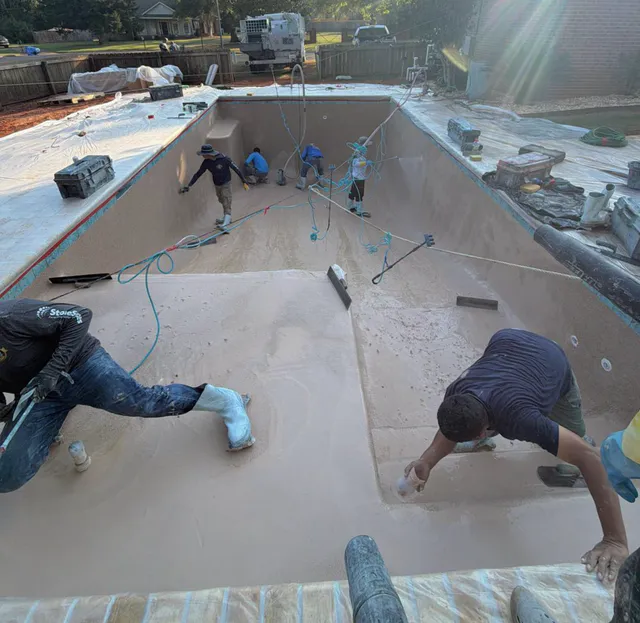
What is included in a pool renovation?
A pool renovation redoes the surfaces you see and touch on a concrete pool whose shell is still sound. Depending on what the site visit finds, it can include:
- Surface preparation and an acid wash, so the new finish can bond to the shell.
- A new interior finish in Quartz series, Mini Pebble, Mini Pebble with glass or regular Pebble, including StoneScapes finishes by NPT (see pool resurfacing).
- New waterline tile in 6x6 porcelain or 1x1 and 1x2 glass mosaic.
- New coping in travertine or brick (see pool coping).
- A new deck in pavers or travertine.
Each project is scoped at a site visit and priced in a written estimate before the work starts. We bring color samples to the site, so you can compare colors at your own pool before choosing.
How much does a pool remodel cost?
Cost guides give national references, not quotes. HomeGuide's pool remodel guide (written June 10, 2024) puts the average range at $5,000 to $30,000, with a national average of $17,500, and an inground pool remodel at $6,000 to $50,000. HomeAdvisor (updated June 2026) reports an average of $10,495, with most projects between $5,601 and $15,767. The individual parts look like this:
| Part of the renovation | National cost reference | Source |
|---|---|---|
| Acid wash | $300 to $700 | HomeGuide (2025) |
| Concrete pool resurfacing | $6 to $15 per sq ft ($6,000 to $15,000) | HomeGuide (2024) |
| Retiling an average-sized pool | $2,500 to $5,000 | HomeGuide (2024) |
| Coping replacement | $30 to $50 per linear ft | HomeAdvisor (2026) |
| Pool patio in concrete, stone or pavers | $5 to $35 per sq ft | HomeGuide (2024) |
| Refilling the pool | $30 to $100 per 1,000 gallons | HomeGuide (2024) |
The real price depends on the pool's size, its condition and the finish you choose, and comes out of the site visit as a written estimate. For a deeper breakdown, see our guide to pool remodel cost.
In what order is a full renovation done?
Order matters because the finish, tile, coping and deck all meet at the pool edge. A public example is the City of Gulf Shores, Alabama pool resurfacing specification, which lists the work in this order:
- Old tile out: waterline, trim and marker tile are removed and the old thinset is ground off.
- Old plaster out: all layers of plaster and paint come off down to the original shell, and the surface is cleaned.
- Acid wash and neutralizing of the shell.
- Bond coat applied to the shell.
- New waterline tile: 6x6 porcelain tile around the pool.
- Finish plaster, no less than 3/8 inch thick at any point.
- Start-up: brushing and water adjustment for 14 consecutive days.
In that sequence the interior finish goes on last, after the tile work. On a residential renovation, the site visit and written estimate come first, and new coping and deck work are planned together with the tile, because all three meet at the pool edge. The National Plasterers Council notes that a pool finish is placed and finished in one single application, and its guidance on filling and start-up says the fill should run continuously and as rapidly as possible once the finish is in.
How long does a pool renovation take?
HomeGuide puts most pool remodels at about 4 to 8 weeks, depending on pool size and scope, while a simple replastering or small repair may take only a few days. The work continues after the water goes in. PoolPro's summary of the NPC start-up procedure calls for brushing a new finish at least twice a day in the first days, and the Gulf Shores specification has the contractor brush and adjust the water for 14 consecutive days. The National Plasterers Council says a new finish is especially susceptible to staining, scaling and discoloration within the first 28 days, and its 2025 filling and start-up guidance says not to turn on the pool heater for 28 days and to keep wheeled vacuums out until the water is balanced and clear, typically 7 to 10 days after the fill.
| Stage | Typical time | Source |
|---|---|---|
| Full pool remodel | 4 to 8 weeks | HomeGuide (2024) |
| Continuous circulation after the fill | At least 72 hours | NPC start-up procedure (PoolPro) |
| Wheeled vacuums kept out | Typically 7 to 10 days | NPC (2025) |
| Brushing and water adjustment in a public spec | 14 days | City of Gulf Shores, AL |
| Start-up care and pool heater off | 28 days | NPC (2025) |
| Finish hydration 30 days after the fill | Only 60 to 70% complete | PoolPro article on the NPC start-up procedure |
Sources differ on how far curing gets in that month: NPT, a finish maker, says on its start-up page that 86% of the cement in plaster cures within the first 28 days. Either way, curing is not finished when the start-up ends. Our guide to new plaster pool startup walks through that first month.
When is it worth renovating everything at once?
When several parts are near the end of their life at the same time. The National Plasterers Council gives these typical surface lives:
| Interior finish | Typical surface life (years) |
|---|---|
| Traditional white plaster | 5 to 8 |
| Polished | 8 to 12 |
| Quartz | 10 to 15 |
| Pebble | 12 to 18 |
If the finish is worn and the tile is loose or the coping is cracked, doing them together means the pool is drained once and the new finish goes on after the tile and edge work, as in the Gulf Shores sequence. HomeGuide also notes that combining projects can save money and time. If only the finish is tired and the tile and coping are sound, resurfacing on its own may be enough. On permits, HomeGuide says a remodel needs one when it involves excavation, plumbing or electrical work, so check your local rules. Related reading: replacing pool coping and travertine vs pavers for a pool deck.
What should Gulf Coast pool owners plan for?
- Groundwater. In southwestern Alabama and the western Florida Panhandle, the USGS 1990 ground water atlas reports a water table from a few feet to about 50 feet down, and just below the surface in low-lying areas. The Gulf Shores specification, written for a pool with a groundwater well-point system, requires that the shell stay empty during the work with the hydrostatic pressure under and around it properly relieved.
- Hurricane season, which runs from June 1 to November 30, according to NOAA. Swim University calls a period of heavy rainfall the worst time to drain a pool, so storm forecasts matter when the work is scheduled.
- Heat. The NPC says there is no standard limiting air temperature for plastering, but hot weather speeds surface drying and can cause shrinkage cracking. Its precautions include starting early in the morning, pre-wetting the shell and tenting the pool.