

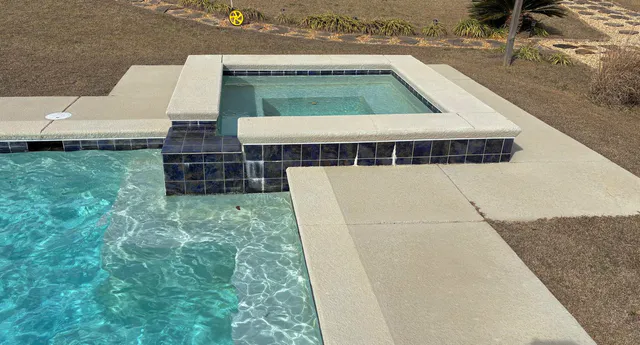
What does waterline tile do?
The waterline is the hardest-working strip of a pool. It sits in the sun, catches oils and debris, and gets wet and dry every day as the level moves. HomeGuide's 2026 pool tile cost guide describes waterline tile as the border just below the coping, where water and chemicals cause the most wear. We set two kinds of waterline tile: 6x6 porcelain and glass mosaic in 1x1 and 1x2 formats.
Porcelain or glass: which pool tile should you choose?
Porcelain is defined by how little water it takes in. The ANSI A137.1 standard counts a ceramic tile as porcelain only if it absorbs 0.5% of its weight in water or less, a class the Tile Council of North America calls impervious. Glass mosaic reflects light and gives the edge more depth and color, and it costs more: HomeGuide lists glass at $8 to $50 per square foot for the tile alone, against $2 to $25 for porcelain. Glass has its own standard, ANSI A137.2, which recommends face-mounted sheets for tile that will sit under water, so the mounting does not get in the way of the bond.
| Tile we install | Face size (inches) | Water absorption | Tile cost per sq ft, material only (HomeGuide, Jan 2026) |
|---|---|---|---|
| Porcelain | 6 x 6 | 0.5% or less, by definition (ANSI A137.1) | $2 to $25 |
| Glass mosaic | 1 x 1 and 1 x 2 | Very low; as an example, one pool-rated glass mosaic, Island Stone's Maris, tested at 0.10% under ISO 10545-3 (Crossville spec sheet, 2026) | $8 to $50 |
The tile must be rated by its maker for submerged use, and so must the setting materials. LATICRETE's pool installation guide, TDS 192, limits pools to impervious tile (under 0.5% absorption) or vitreous tile (under 3%), because tile that absorbs more than 3% can swell for good from moisture. We bring samples to the site so you can see each tile next to your coping and your water before choosing.
How much does pool tile replacement cost, and how long does it last?
National cost guides agree on price more than on lifespan. Use these as national reference points, not as a quote. The real number depends on the length of the waterline, the tile you pick, the condition of the wall behind the old tile and whether the pool is being resurfaced at the same time, and it comes out of the site visit and a written estimate.
| Source | Waterline tile, installed | How long pool tile lasts |
|---|---|---|
| HomeGuide (January 2026) | $1,900 to $4,800 on a 16 x 32 ft pool | No number given |
| Angi (September 2026) | About $25 per linear foot | 5 to 10 years, depending on care; reseal grout every 3 to 5 years |
| HomeAdvisor (June 2026) | About $25 per linear foot | Most pool tile 10 to 20 years |
Can you replace pool tile without draining the pool?
For a waterline job, usually yes. Angi's tile replacement guide notes that the water only has to come down far enough for the tile being replaced to sit dry and above the surface, and HomeGuide says some waterline replacements can be done without draining, while a full retile always needs the pool empty. If the interior finish is being redone too, the pool is drained anyway, and it makes sense to set the new tile in the same project.
How is waterline tile replaced?
- Lower the water below the tile band.
- Remove the old tile and its setting bed, and check the concrete behind it for loose or hollow spots.
- Set the new tile with a pool-rated thin-set. LATICRETE's pool design manual calls for at least 24 hours of cure at 70°F before grouting when its products are used.
- Grout, then seal the tile-to-coping joint with a flexible sealant made for it. W. R. Meadows rates its Deck-O-Seal One Step for the joint where tile meets coping above the waterline.
- Cure, then refill. For pools tiled with LATICRETE's own products, TDS 192 asks for an average minimum cure of 14 days at 70°F with latex-fortified portland cement grout, or 10 days with epoxy grout, before the pool is filled, and a fill rate of about 2 feet per 24 hours. Those are LATICRETE's figures; with another brand, the fill date follows that maker's printed cure time.
Heat changes that clock. LATICRETE's rule of thumb is that cement and epoxy setting materials cure about twice as fast for every 18°F above 70°F, so a July job on the Gulf Coast and a January job do not run on the same schedule.
Why does pool tile fall off?
Angi lists the usual causes of cracked, chipped or loose pool tile as poor installation, freeze and thaw cycles and age. LATICRETE adds two that show up at the waterline: tile that absorbs too much water and swells, and mosaic sheets whose backing loses its grip after soaking in pool water. When tiles sound hollow or come loose, the setting bed behind them should be checked before choosing between a spot repair and a new band.
How do you remove calcium from pool tile?
The white crust at the waterline is calcium scale. National Pool Tile (NPT) describes two kinds: calcium carbonate, a fine white film that builds up in layers and comes off with regular cleaning, and calcium silicate, a sharp, crystal-like buildup linked to high pH and calcium that takes more work. NPT's tile care guide ties scale to water balance: a Langelier Saturation Index (LSI) between 0.0 and 0.5 is acceptable, and above 0.5 scale builds faster. It advises against pumice stones and 50/50 brushes, which can damage tile, and recommends a non-acidic calcium cleaner with a nylon brush or pad. Heavy scale calls for media blasting by a tile cleaning specialist, and NPT notes that baking soda media removes scale and is safe for tile, glass included.
Acid cleaners can burn skin and eyes, and NPT warns that certain acids damage tile glaze and iridescent glass. Read the label and the safety data sheet, or leave heavy scale to a professional. Our guide on how to remove calcium from pool tile goes through the options.
What should Gulf Coast owners know about pool tile?
A 1979 U.S. Geological Survey report on water in the Pensacola area described the groundwater of the sand-and-gravel aquifer, the main source of the local supply, as remarkably soft, with very small amounts of dissolved minerals. That describes untreated aquifer water more than 45 years ago, not what comes out of your tap today, so test the fill water for calcium hardness, pH and alkalinity before blaming scale on it.
Should tile be planned with coping and resurfacing?
The tile band sits between the pool coping and the interior finish, so it is often planned together with new coping or a pool resurfacing job, which keeps the lines of the pool consistent and avoids damaging new work. A full pool renovation covers all three. For more detail, read glass vs porcelain pool tile, what replacing pool tile involves and our waterline tile ideas. Before any work we visit the pool and give you a written estimate; you can request a visit here.