

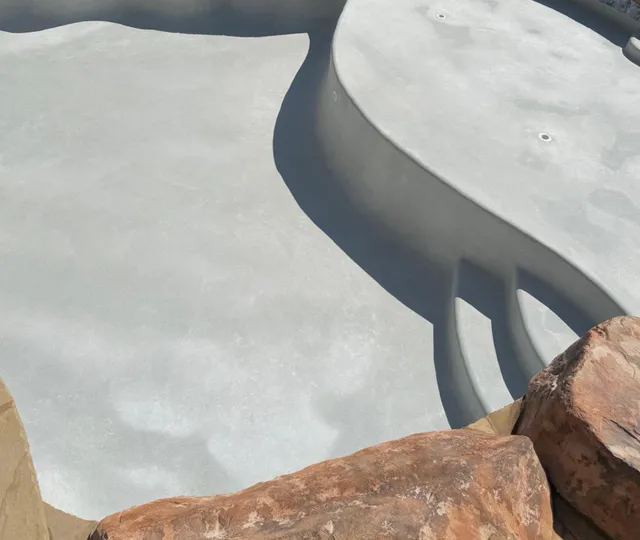
What is pool resurfacing?
Pool resurfacing is the work of giving a concrete pool that already exists a new interior finish. HomeGuide's 2025 cost guide describes it as removing the existing finish by chipping, sandblasting, hydro-blasting or chemical stripping, then applying a new surface. When the new surface is plaster, the job is usually called a replaster. When it is quartz or pebble, most people still call it resurfacing. To compare the materials, see our pages on quartz pool plaster and pebble pool finishes.
How do you know a pool needs resurfacing?
A pool usually needs a new finish when the surface turns rough to the touch, stains no longer come off with brushing, the plaster shows etching or bare spots, or pieces start to delaminate. HomeGuide also lists:
- Flaking or peeling plaster, chips or cracks in the surface
- Stains or discoloration that cannot be cleaned off
- Loss of pebbles or other aggregate from the surface
- Corroded tile grout and a chalky residue near the edges
How soon this happens depends on the finish. HomeGuide puts standard plaster at 7 to 12 years, quartz plaster at 10 to 15 years and pebble at 15 to 20 years or more. If you are weighing the price against the years you get back, our guide on whether pool resurfacing is worth it walks through the math, and the pool resurfacing cost guide covers national price ranges.
Which finishes can a resurfaced pool get?
We work with four families of interior finish: Quartz series, Mini Pebble, Mini Pebble with glass and regular Pebble. Quartz gives a smoother feel and a wide range of water colors. The pebble finishes have more texture and a natural stone look. We are a StoneScapes applicator (StoneScapes is the pebble finish line made by NPT) and we also work with other finish brands. We bring samples to the site so you can see each color wet and in daylight before choosing.
How long does pool resurfacing take?
HomeGuide says resurfacing takes 5 to 7 days on average, depending on the pool size, the material and the finish. The water start-up comes after that: the National Plasterers Council (NPC) treats the first 28 days after the refill as the critical period. The table shows a typical sequence and the source of each time. The real schedule depends on the weather, the pool size and what we find once it is empty; we confirm it in the written estimate.
| Step | What happens | Typical time (source) |
|---|---|---|
| 1. Drain and inspect | The pool is emptied in a dry spell and the shell is checked for hollow spots, cracks and leaks. | Part of the 5 to 7 days (HomeGuide) |
| 2. Prepare the surface | Loose or hollow finish is removed and the surface is cleaned or etched so the new finish can bond. Cracks and leaks are fixed first. | Part of the 5 to 7 days (HomeGuide) |
| 3. Apply the new finish | The finish is troweled on, then aggregate finishes are washed to expose the stone. After the finish sits overnight, a light cleaning wash removes the cement film. | Exposure window of about 1 to 1.5 hours, then an overnight wait before the cleaning wash (Universal White Cement) |
| 4. Refill | The pool is filled without stopping, which the NPC says helps prevent a bowl ring and shrinkage cracking. | 12 to 36 hours with a garden hose (HomeGuide) |
| 5. Start-up | Daily brushing, testing and adjusting. Pumps run nonstop. | At least 72 hours of nonstop filtration, and 28 days of extra care (NPC) |
What happens during surface preparation?
HomeGuide notes that a concrete shell must be sandblasted or chemically etched before resurfacing. Surface preparation is part of our resurfacing work, and depending on the condition of the shell it can include an acid wash or removing loose material. An empty pool is also the time to look for cracks and leaks: HomeGuide warns that cracks left untreated can spread and damage the new finish, so repairs come before the finish goes on.
What is the water start-up after the pool is refilled?
A new cement-based finish is still curing when the water goes in. The National Plasterers Council's most recent guidance, its 2025 White Paper 6 on filling and initial start-up, says the interior finish is especially susceptible to staining, scaling and discoloration within the first 28 days, and it still recommends the council's start-up card (REV 03-2021) for the day-by-day steps. The main points:
- Brush the whole surface at least twice a day to remove the plaster dust (card).
- Run the pump and filter nonstop for seven days, or until the dust is gone and the water is clear, with a minimum of 72 hours (card).
- Keep wheeled vacuums out until the water is balanced and no plaster dust remains, typically 7 to 10 days after the fill, or as the finish maker directs (White Paper 6; the earlier card said 28 days).
- Keep the pool heater off for 28 days (White Paper 6).
- In a salt water pool, do not add salt within the first 30 days (card).
- Keep people and pets out of the pool while it fills.
The start-up also involves testing and adjusting the water every day. Agree before the fill on who will handle it, since the NPC's white paper says it is important to determine who will perform the start-up. Our article on new pool plaster start-up explains each day. Pool chemicals call for care: read the label and safety data sheet, or have a pool professional handle them.
How do you care for a resurfaced pool?
The NPC recommends testing pH, total alkalinity and chlorine one to two times a week, and calcium hardness, stabilizer and total dissolved solids once a month. Its start-up card asks owners to keep the Langelier Saturation Index between 0.0 and +0.3, especially in the first six months. Water with low calcium hardness, low pH or low alkalinity is what the NPC calls aggressive, and it slowly etches cement-based finishes.
Should tile and coping be replaced at the same time?
Often, yes. The waterline tile sits between the coping and the interior finish, so work on one later often disturbs the others. When the tile is cracked or the coping is loose, it usually makes sense to plan new waterline tile, new coping and the new finish as one project. That way the pool is drained only once.
What should Gulf Coast pool owners know before draining?
The Florida Swimming Pool Association warns that a drained pool is exposed to pressure from saturated ground, which can push the shell out of the ground. UF/IFAS Extension adds that heavy rain can build pressure outside an empty pool and crack it. Pensacola gets 68.31 inches of rain in a normal year at its airport station, according to NOAA's 1991 to 2020 climate normals, and the Atlantic hurricane season runs from June 1 to November 30, per NOAA. So the drain should be planned around the forecast, with the pool empty only as long as the work needs. Our guide on draining a pool for resurfacing covers the other checks. A 1979 USGS report on the Pensacola area describes the groundwater of the area's sand-and-gravel aquifer as remarkably soft. That is untreated aquifer water, not tap water, so the fill water is tested, as the NPC asks. If its calcium hardness is low, the NPC's White Paper 7 (August 2025) recommends bringing the fill water above 200 ppm, for example by dosing calcium chloride as the pool fills.
New pools and renovations
We finish new pools for builders and resurface existing pools for homeowners across our service area. Every job starts with a site visit and a written estimate, because the price and the schedule depend on the pool size, its condition and the finish you choose.