

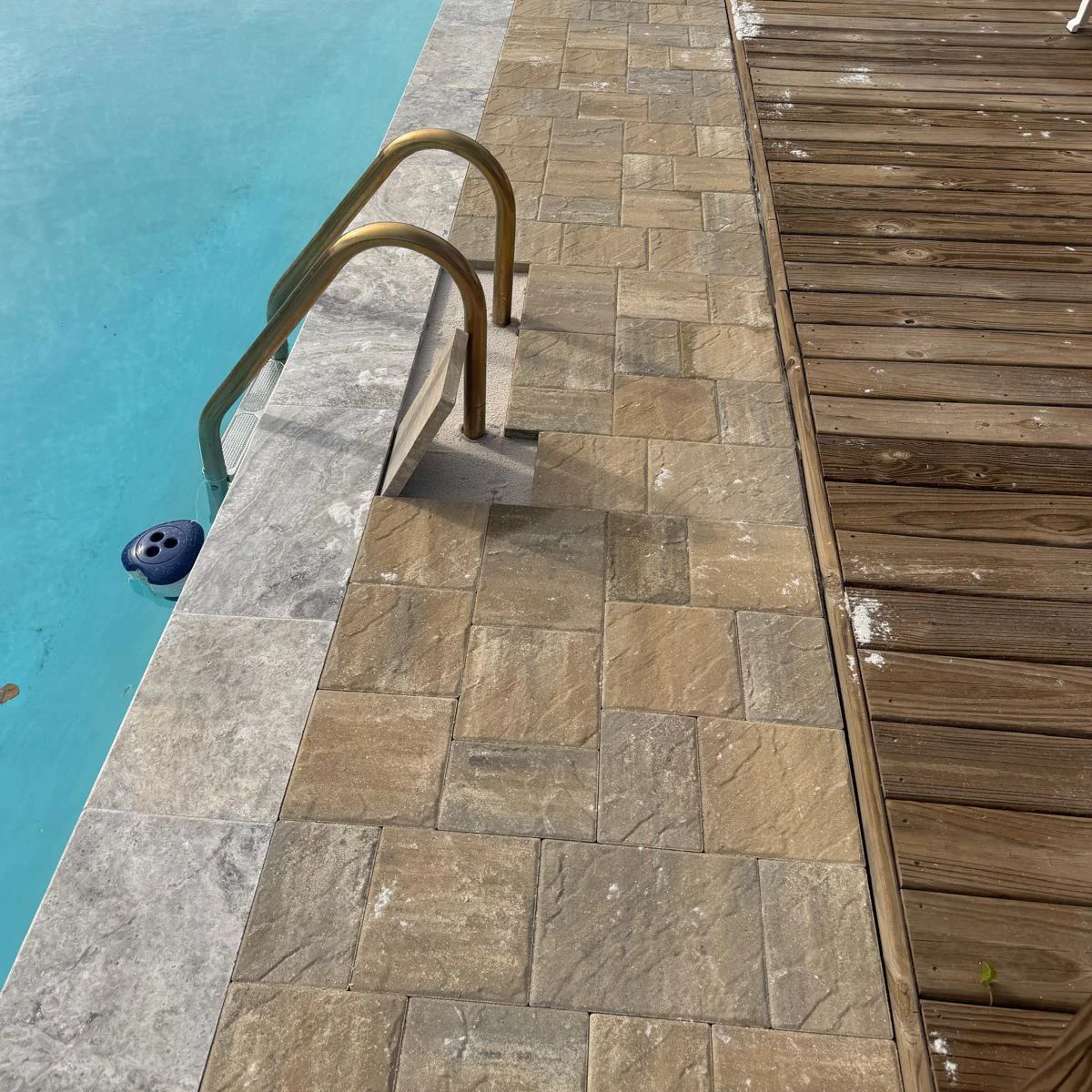
Pavers or travertine: which pool deck is right for you?
Both are laid as individual units rather than one poured slab, and both pair with the coping we install. Concrete pavers come in many shapes and colors. Under ASTM C936, the U.S. standard as summarized by the Interlocking Concrete Pavement Institute (ICPI) in its Tech Spec 2 (2017 revision), they need an average compressive strength of at least 8,000 psi and absorb no more than 5% water. Travertine pavers give a natural stone look and can match travertine coping from the same stone; MSI, for example, sells its Tuscany Porcini travertine both as coping and as 3 cm pavers from 8 x 8 to 16 x 24 inches.
| Feature | Concrete pavers | Travertine pavers |
|---|---|---|
| Typical thickness | 2 3/8 in (60 mm) for pedestrian areas (ICPI) | 3 cm, about 1 1/4 in (example: MSI) |
| Common sizes | Many shapes and patterns | 8 x 8, 8 x 16, 16 x 16 and 16 x 24 in (example: MSI) |
| Material standard | ASTM C936: 8,000 psi average, 5% maximum absorption | ASTM C1527, exterior class: 7,500 psi minimum, 2.5% maximum absorption (minimums as transcribed in a CTS lab test report for Durango Stone) |
| Installed cost per sq ft (HomeGuide, Dec 2025) | $10 to $17 (paver patio) | $16 to $35 (natural stone patio) |
| Repair | Lift and reset single pieces | Lift and reset single pieces |
HomeGuide adds about $5 per square foot when an old deck has to be removed first. These are national references, not our price; the real number depends on the size of the deck, the material, what has to come out and the soil, and it comes out of the site visit and a written estimate.
What goes under a paver or travertine pool deck?
The base does most of the work. ICPI's Tech Spec 2 calls for at least 4 inches of compacted aggregate base under patios and walkways over well-drained soil, under a bedding sand layer of about 1 inch, and notes that the right thickness depends on the soil, its drainage and moisture, the traffic and the climate. ICPI's Tech Spec 10 gives 4 to 6 inches of base for walks, and MSI's hardscape installation manual uses the same 4-inch minimum of crushed rock for patios.
| Layer, top to bottom | Typical thickness or slope | Source |
|---|---|---|
| Concrete paver | 2 3/8 in | ICPI Tech Spec 2 |
| Travertine paver | 3 cm (about 1 1/4 in) | MSI |
| Bedding sand | About 1 in | ICPI Tech Spec 2 |
| Compacted aggregate base | 4 to 6 in for walks and patios | ICPI Tech Spec 10 |
| Deck surface slope | 1/8 to 1/2 in per foot, away from the pool | ISPSC 306.5 (model code; your local code governs) |
Which way should a pool deck slope?
Away from the pool, or toward deck drains. The International Swimming Pool and Spa Code (ISPSC), the model code published by the International Code Council, sets a minimum slope of 1/8 inch per foot for travertine or brick-set pavers at residential pools and a maximum of 1/2 inch per foot for decks, and its 2024 edition says decks must drain away from the pool or toward deck drains. On a 10-foot run, 1/8 inch per foot works out to 1 1/4 inches of fall. The ISPSC is a model code: it applies only where a state or local government adopts it, with or without changes, so the code your city or county has adopted is the one that governs the slope.
Which pool deck material stays coolest in the sun?
The one that reflects the most sunlight. The U.S. EPA's cool pavements guide notes that conventional concrete and asphalt can reach 120 to 150°F at peak summer temperatures and names solar reflectance, the share of sunlight a surface bounces back, as the main determinant of a material's maximum surface temperature. It also notes that reflective pavements are light colored and cites Lawrence Berkeley National Laboratory researchers' estimate that every 10% increase in solar reflectance can lower surface temperature by about 7°F. So, whatever the material, the shade you pick changes how hot the deck gets, and we bring samples you can stand on in your own yard.
Can a damaged paver be replaced on its own?
Yes. ICPI's Tech Spec 10 explains that pavers do not rely on one continuous slab for their strength, so pieces can be lifted and the same units reinstated after a repair underneath, such as a settled spot or a pipe. HomeGuide makes the same point for paver coping.
How is a paver or travertine pool deck built?
- Excavate and compact the soil, shaping the slope away from the pool.
- Place and compact the aggregate base, 4 to 6 inches for walks and patios per ICPI.
- Screed about 1 inch of bedding sand. MSI's manual says to screed only as much sand as can be covered with pavers that same day.
- Lay the pavers or travertine, cut the edges against the coping and set an edge restraint.
- Fill the joints. With polymeric sand, Techniseal's product guide asks for about 24 hours without rain and allows foot traffic right away.
- Seal, if you choose to, after the joints cure. Techniseal recommends waiting at least 30 days after polymeric sand before cleaning and sealing the pavers.
The joint where the deck meets the coping is sealed with a flexible sealant rather than sand or grout; our pool coping page explains why and gives the joint sizes.
How do you care for a paver or travertine deck?
Rinse it, keep the joints full and catch low spots early. MSI suggests saving leftover joint sand to top up joints that wind or rain empty over time. If the pool runs on a salt chlorine generator, Hayward's owner's manuals advise asking a stone installation specialist about the type, installation, sealant and upkeep of natural stone decking next to a salt pool.
What should Gulf Coast owners know about pool decks?
Pensacola gets 68.31 inches of rain in a normal year at its airport station, according to NOAA's 1991 to 2020 climate normals. That is why slope and a well-compacted base carry so much weight here: water has to run off the deck and away from the pool, and the base has to hold its shape after heavy storms. In full sun, a more reflective, lighter deck surface is also worth a look, for the reasons above.
Should the deck be built together with the coping?
The deck meets the coping all the way around the pool. Building them in the same project keeps the joints, the slope away from the water and the change from one material to the other under one plan, and a full pool renovation can bring the deck, coping and waterline tile up to date at once. For more, read travertine vs pavers for a pool deck, our pool deck ideas and what a pool remodel costs. Before any work we visit the pool and give you a written estimate; you can request a visit here.