Pool care · · 6 min read
How to Remove Calcium From Pool Tile (and Keep It Off)
Most calcium on pool tile forms where water wicks 1/4 to 3/4 inch above the line. How to identify it, what removes it, what it costs and why to skip CLR.
By Outdoor Hardscapes Pool Finishes, pool finishing contractor in Pensacola, FL.
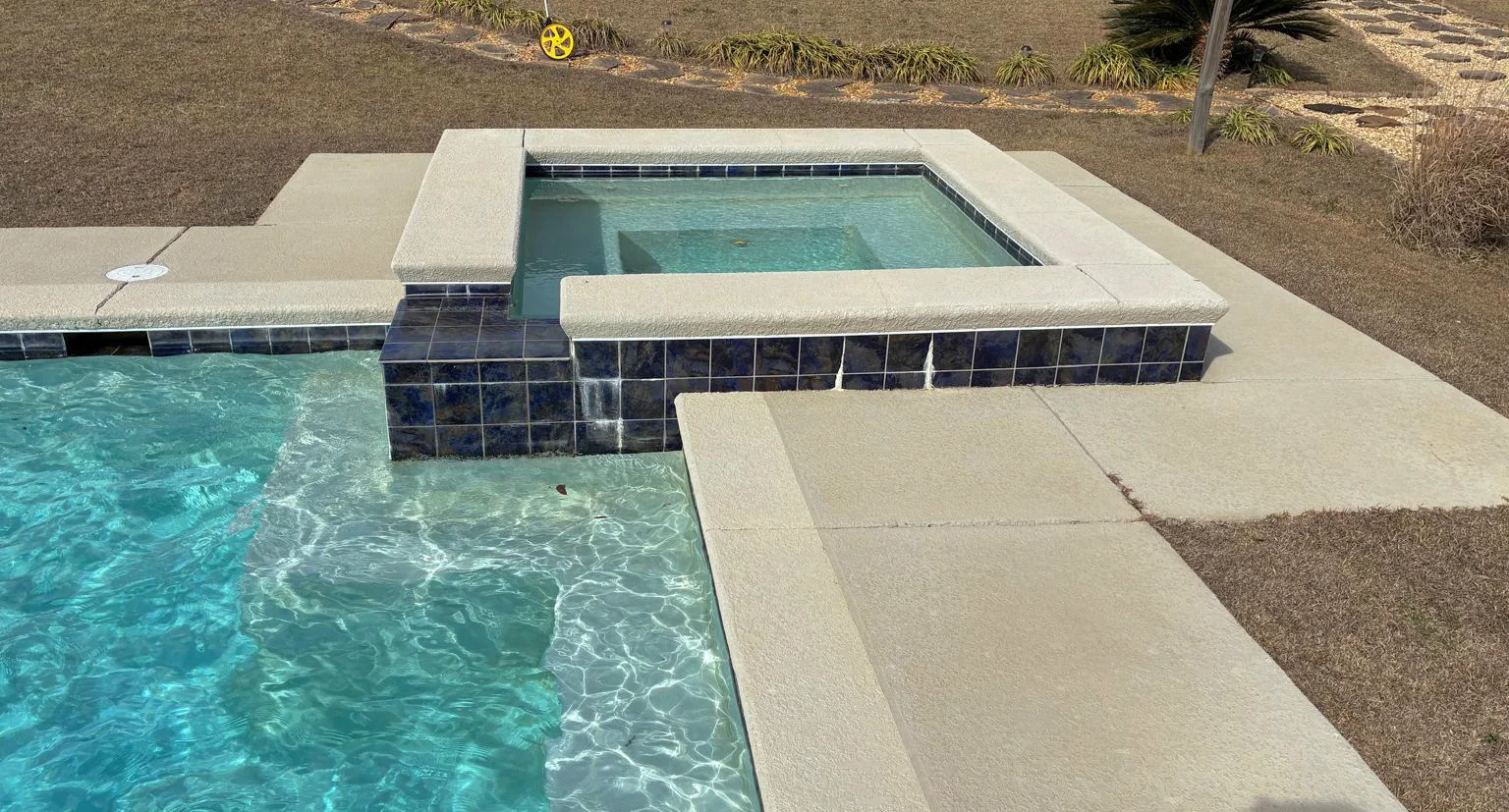
Most of the white crust on pool tile is not a chemistry mistake. It forms because pool water wicks 1/4 to 3/4 inch up the tile face and evaporates, leaving its minerals behind, according to a January 2025 AQUA Magazine article by the onBalance team. Regular brushing slows the band; hard, built-up deposits usually need professional media blasting, which Fixr’s January 2025 cost guide puts at $1.50 to $3 per square foot of tile.
What works on your pool depends on three things: what the deposit is, what the tile is made of and whether the buildup sits above or below the water. Here is how to tell the deposits apart, what removes each one and what national cost guides say it costs.
What does calcium buildup on pool tiles look like?
Two deposits are common, a third turns up less often, and from the deck they look alike:
- Evaporation line. A white or gray band just above the water, about as tall as the water wicks up the tile. AQUA’s authors call it an evaporite: the residue of whatever was dissolved in the water, mostly salt and calcium carbonate, plus traces of metals, oils and pollen. It forms even in well-balanced water.
- Calcium carbonate scale at or below the waterline. Orenda, a pool chemical maker, draws the line this way: calcium above the waterline is likely from evaporation, while calcium at or below it is likely from a high LSI, meaning water oversaturated with calcium carbonate. Orenda counts an LSI of +0.31 or higher as oversaturated.
- Calcium silicate, less often. Orenda says silica scale sometimes forms on cement-based surfaces, often looks rounded, almost like kernels of rice, and is apparently immune to muriatic acid, with no chemical remover it knows of. It has to come off mechanically.
The difference matters because acid dissolves carbonate and, by Orenda’s account, leaves silicate untouched. That is one more reason to have a professional look at a hard deposit before anyone chooses a method, and anything involving acid belongs to someone with the right protective gear.
Why does calcium build up on pool tile?
Evaporation drives the band above the water. AQUA’s authors say the deposit grows faster with higher evaporation rates and with more hardness or dissolved solids in the water, and that adjusting the saturation index cannot prevent it. What slows it is lower calcium and dissolved solids in the water, and less evaporation.
Below the waterline, chemistry decides. Water with a high LSI, usually from high pH, high alkalinity or high calcium, deposits calcium carbonate on whatever it touches, tile included.
Fill water plays a part too. Orenda notes that hard tap water raises calcium every time the pool is topped up after evaporation, while soft tap water slowly dilutes it. Around Pensacola, a 1986 U.S. Geological Survey report found hardness generally below 10 mg/L in the untreated water of the sand-and-gravel aquifer that supplies the area. Treatment can change that before it reaches your hose, so test your fill water instead of assuming; our calcium hardness guide explains what to test and why. When a tile line builds up fast, testing the pool water and the fill water side by side shows which one is carrying the calcium.
Does CLR remove calcium from pool tile?
Do not use it on pool tile. CLR Brands, the company that makes it, says its Calcium, Lime and Rust Remover is not recommended for use in or around swimming pools, including pool tile. The company says the product may damage or remove the tile’s finish, and that contact with chlorine or other pool chemicals can create toxic fumes. Its advice is to ask a pool maintenance professional for a product that is safe for the surface.
The same logic applies to any household descaler near a chlorinated pool: if the label does not say it is made for pool tile, keep it away from the water.
What is the best thing to clean pool tiles with?
Match the method to the deposit and the tile, from gentlest to strongest:
- Regular brushing. AQUA’s authors note that when the tile line is brushed regularly and the water at the surface keeps moving, the more soluble part of the residue goes back into the pool water. What tends to stay behind is the least soluble part, usually calcium carbonate, which is why brushing slows a band but rarely erases an old one. Use a brush and cleaner labeled for your tile.
- Professional media blasting. For hard deposits, a tile cleaner lowers the water below the tile and blasts the deposit off with fine media. In 2021, PoolPro profiled a California contractor who drains the water 8 inches below the tile line and works with glass bead, crushed glass or a softer media, depending on the tile. Glass tile, black tile, marble and very thick deposits get the softer media so the tile is not scratched or etched. Orenda also lists bead blasting and grinding for tile lines.
- Acid, only by a professional. Orenda lists diluted acid as an option, used with caution, with protective gear and with the acid neutralized so the pool’s pH does not drop too far, and it recommends against applying acid directly to scale. We treat this as professional work. HomeGuide prices a professional acid wash of tile and grout at $150 to $300. Our pool acid wash guide covers the risks of acid on cement surfaces.
- Replacement. Tile that is etched, cracked or loose will not come back with cleaning. Our guide to replacing pool tile explains when a new waterline makes more sense.
How much does it cost to remove calcium from pool tile?
National guides price tile cleaning in different units, so treat these as references. Tile type, deposit thickness and minimum charges all move the final number:
| Option | Price reference | Source |
|---|---|---|
| Sandblasting tile | $1.50 to $3 per sq ft | Fixr, January 2025 |
| Professional acid wash of tile and grout | $150 to $300 | HomeGuide, July 2025 |
| Bead blasting porcelain tile (one Arizona contractor) | from $4.50 per linear ft | PoolPro, 2021 |
| Softer media on glass tile (same contractor) | from $5.50 per linear ft | PoolPro, 2021 |
| Tile repair or retiling, labor included | $25 to $30 per sq ft | HomeGuide, July 2025 |
The Arizona contractor told PoolPro in 2021 that fixed pricing is hard because there are so many variables, and that pools with very thick buildup are bid accordingly. The two PoolPro rows are one company’s 2021 prices, not a national range. New waterline tile is priced the same way: we give a written estimate after a site visit, once we have seen the tile.
How do you keep calcium off pool tile?
You cannot stop an evaporation line completely, but you can slow it down:
- Keep calcium and dissolved solids from creeping up. AQUA’s authors say lower concentrations slow the deposit, and higher ones speed it up.
- Keep the LSI from running high. A positive, scale-forming LSI adds carbonate scale at and below the waterline on top of the evaporation band.
- Brush the tile line on a schedule. Regular brushing returns the soluble part of the residue to the water before it builds.
- Cut evaporation where you can. AQUA’s authors say lower evaporation slows the deposit, and HomeGuide’s maintenance guide lists a manual or automatic pool cover as a way to lessen evaporation.
If the waterline is past cleaning, our pool tile work includes new waterline tile in 6x6 porcelain and 1x1 or 1x2 glass mosaic, and a pool renovation can pair new tile with a new interior and coping in one project.
If you are in Pensacola, Alabama or the Mississippi Gulf Coast and want a second opinion on your pool, request an estimate.
Sources
- Just Above the Waterline, AQUA Magazine (Que Hales, Doug Latta and Kim Skinner, onBalance), accessed November 25, 2026.
- How to Manage Scale-Forming or Hard Tap Water, Orenda Technologies, accessed November 25, 2026.
- Understanding Calcium Carbonate Scale, Orenda Technologies, accessed November 25, 2026.
- Calcium, Lime and Rust Remover, CLR Brands, accessed November 25, 2026.
- Expanding into Tile Cleaning, PoolPro Magazine, accessed November 25, 2026.
- Sandblasting Cost, Fixr, accessed November 25, 2026.
- How Much Does It Cost to Repair a Pool?, HomeGuide, accessed November 25, 2026.
- How Much Does It Cost to Own and Maintain a Swimming Pool?, HomeGuide, accessed November 25, 2026.
- Water for Florida Cities (Water-Resources Investigations Report 86-4122), U.S. Geological Survey, accessed November 25, 2026.