

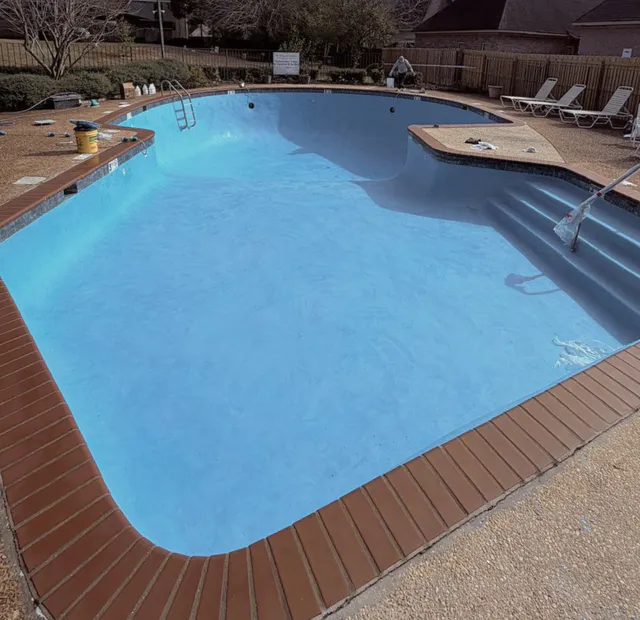
What is a pool acid wash?
An acid wash is a deep cleaning for plaster and other cement-based pool finishes. The pool is drained, and a diluted solution of muriatic (hydrochloric) acid dissolves a very thin layer of the surface, taking with it stains, scale and algae marks that brushing can no longer remove. The National Plasterers Council glossary describes the stain-removal version as a low-strength, diluted solution that removes stains "with little, if any, of the cementitious surface being compromised."
How much plaster does an acid wash remove?
There is no official per-wash figure from the National Plasterers Council or a finish maker; HomeGuide (2025) describes it only as a very thin layer. The number that circulates is an estimate from the pool service software company PoolDial: about 1/16 inch per wash, with standard white plaster able to take 3 to 4 washes in its lifetime. Treat it as a rough guide, not a measurement. For context, the City of Gulf Shores, Alabama pool resurfacing specification requires new finish plaster no thinner than 3/8 inch at any point, and a contractor quoted by Pool & Spa News prefers the plaster to be at least 3/8 or 1/2 inch thick before an acid wash, with a weaker solution, if anything, on thinner plaster.
| Acid wash number | Value | Source |
|---|---|---|
| Plaster removed per wash (software company estimate, not an official figure) | About 1/16 in | PoolDial |
| Washes standard white plaster can take (same estimate) | 3 to 4 | PoolDial |
| Minimum new plaster thickness in a Gulf Coast public spec | 3/8 in | City of Gulf Shores, AL |
| Plaster thickness one contractor prefers before a wash | 3/8 to 1/2 in | Pool & Spa News (2016) |
| Interval some pros recommend | 3 to 7 years | HomeGuide (2025) |
When does an acid wash solve the problem?
It is the right tool when the plaster is sound and the problem is on the surface:
- Stains that chemistry cannot lift. Pinch A Penny says a wash may be needed when stains cannot be eliminated through chemical treatment of the water.
- Calcium scale and mineral deposits bonded to the finish.
- Algae stains left after a green pool is cleared.
- Preparation for a new finish. The shell is acid washed and neutralized so the new finish can bond. The Gulf Shores specification lists that step right before the bond coat, and it is part of the preparation in a full pool renovation.
Not every stain needs acid. Marcano told PoolPro that acid washing "should only be used when necessary," and that balanced water chemistry, weekly brushing and prompt stain treatment help keep stains from settling in. PoolPro's summary of the NPC start-up procedure adds that a quick drain and acid wash is not always the right solution, so the cause of a stain comes first. Our guide to pool stains by color shows how to identify a stain first.
When is an acid wash the wrong fix?
Acid removes material, so it cannot repair a worn-out finish. It usually makes things worse when:
- the plaster is already thin, rough or etched, and Pool & Spa News lists plaster too thin to take an acid wash among the flaws to look for;
- there are cracks, or bulges that sound hollow when tapped, which Pool & Spa News describes as plaster separated from the shell (delamination), adding that it is best to avoid acid washing where there are cracks;
- the finish is old or has been washed several times, where Pinch A Penny advises against more washing;
- the finish is pebble or Mini Pebble, where HomeGuide notes that acid dissolves the cement between the stones and leaves a rougher texture, so the finish maker's care guidance comes first.
In those cases the answer is a new interior finish. The National Plasterers Council says resurfacing becomes necessary when cracks and deterioration can no longer be patched or repaired. See pool resurfacing and our pebble and Mini Pebble finishes.
How often is it safe to acid wash a pool?
As rarely as possible. HomeGuide (2025) says some professionals recommend a wash every 3 to 7 years depending on condition, and that most well-maintained pools need one only every other time the water is drained. A pool that seems to need acid every season usually has a water balance or finish problem acid will not cure. See our pool acid wash guide for more on when a wash makes sense.
How much does a pool acid wash cost?
National cost guides give a reference, not a quote. HomeGuide (2025) puts most residential inground pools at $300 to $700, or $0.50 to $0.75 per square foot of interior surface, with a national average of $450. Angi gives $250 to $600 on average in 2026. HomeGuide lists draining separately at $150 to $250.
| Pool size (ft) | Interior surface (sq ft) | National cost range (HomeGuide, 2025) |
|---|---|---|
| 10 x 20 | 470 | $240 to $350 |
| 12 x 24 | 610 | $300 to $460 |
| 14 x 28 | 770 | $390 to $580 |
| 16 x 32 | 940 | $470 to $700 |
| 18 x 36 | 1,130 | $570 to $850 |
| 20 x 40 | 1,340 | $670 to $1,000 |
The real price depends on size, condition and finish, and comes out of the site visit as a written estimate.
Does the pool have to be drained?
Yes, and HomeGuide lists draining among the main risks of the job: groundwater can create hydrostatic pressure strong enough to push an empty concrete pool out of the ground, and plaster can delaminate as an empty pool heats and cools. Swim University adds that the risk is higher after several days of heavy rain, calls a period of heavy rainfall the worst time to drain, and explains the hydrostatic relief valves in the floor that let groundwater into a drained pool instead of lifting it. Even the Gulf Shores public specification requires that hydrostatic pressure under and around the shell be properly relieved while the pool is empty. More in our guide to draining a pool for resurfacing.
What happens during a professional acid wash?
Details change with the finish, but the sources on this page describe the same general sequence:
- Diagnosis first. The cause of the stain is identified before acid is chosen, and Pool & Spa News notes that pros look for cracks and for bulges that sound hollow when tapped.
- Draining in a dry stretch of weather. Marcano says mild, dry days give the best conditions.
- Washing in sections, then brushing and rinsing. Marcano says to prewet the plaster so the acid does not penetrate too deeply, and Angi says an acid wash averages about four hours of work.
- Neutralizing. Marcano says the acid must be neutralized before disposal, runoff kept out of storm drains and landscaping, and the surface rinsed with a bicarbonate solution before refilling.
- Refill and balance. PoolDial estimates about 2 days from start to swim-ready, counting the drain and the refill.
This page does not give acid ratios or contact times. Marcano warns that too strong a solution can etch beyond the stain and leave rough, uneven plaster.
Is it safe to acid wash a pool yourself?
No. HomeGuide (2025) says homeowners should not attempt acid washing because of the safety hazards: muriatic acid is highly corrosive and can cause severe skin burns, eye damage and respiratory injuries. The CDC estimates a median of 4,535 U.S. emergency department visits a year for pool chemical injuries from 2008 to 2017, and at least 56.3 percent of the injuries in 2015 to 2017 happened at a residence. Its advice for any pool chemical: read the full label or safety data sheet, wear goggles, gloves and a mask, work with good ventilation, and never mix chlorine products with acid.
What is different on the Gulf Coast?
- A high water table. In southwestern Alabama and the western Florida Panhandle, including Escambia and Santa Rosa counties, the USGS 1990 ground water atlas reports a water table from a few feet to about 50 feet down, and just below the surface in low-lying areas. Pinch A Penny warns that drained pools can float or pop out of the ground "especially in places like Florida."
- Storm season. The Atlantic hurricane season runs from June 1 to November 30, according to NOAA. Ground soaked by a tropical system is the heavy-rain situation Swim University warns about.
- Humidity. Marcano notes that high humidity makes acid fumes more intense and harder to clear, and that mild, dry days work best.