

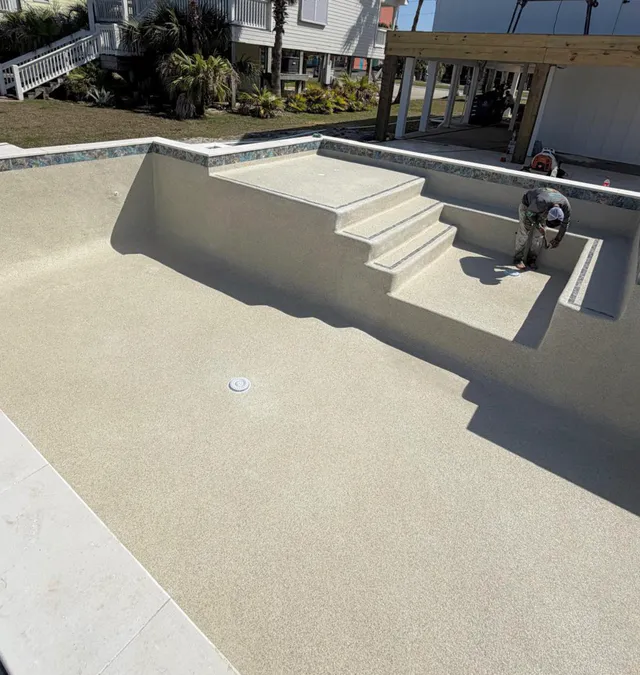
What is pool plaster?
Pool plaster is the cement-based coat that lines the inside of a concrete pool. According to the National Plasterers Council (NPC), standard white plaster is typically made from white cement, white marble aggregate and water, and it gives the water the familiar light-blue look. It is also called marcite. Quartz finishes belong to the same family: plaster with colored ceramic-coated quartz aggregate, which the NPC says can create a harder surface than traditional plaster. This page is about the material. The plaster-family finish we apply is our Quartz series; white and colored marcite are explained here so you can compare. If your pool already has a worn finish, our pool resurfacing page explains the replaster process on an existing pool step by step.
What is the difference between white plaster, colored plaster and quartz?
All three are troweled over the shell and end up smooth to the touch. The difference is in the aggregate and the pigment, and that changes the color, the hardness and how long the surface lasts. The table uses the national figures from HomeGuide's 2025 pool resurfacing cost guide, with pebble added for comparison.
| Finish | Made of | Typical life (HomeGuide) | National cost per sq ft (HomeGuide) |
|---|---|---|---|
| White plaster (marcite) | White cement, white marble aggregate and water | 7 to 12 years | $6 to $8 |
| Colored plaster | Plaster with added pigment | Not listed separately | Not listed separately |
| Quartz plaster | Plaster with colored quartz aggregate | 10 to 15 years | $7 to $10 |
| Pebble (for comparison) | Cement with small exposed pebbles | 15 to 20+ years | $7 to $15 |
These are national ranges, not a quote. The real cost depends on the pool size, its condition and the finish, and comes out of the site visit. On colored plaster, the NPC says pigment can make mottling, streaking and shade variation more visible, and the final color may differ from the sample. Quartz carries color in the aggregate itself, which HomeGuide describes as giving the surface a speckled appearance.
How is plaster different from a pebble finish?
Plaster and quartz are smooth. A pebble finish leaves small stones exposed at the surface, so it feels more textured underfoot and usually costs more up front, according to the NPC, which also notes that stone aggregates can offer strong resistance to many chemical conditions. The NPC's Technical Bulletin 3 adds that cosmetic irregularities are more noticeable on smooth trowel finishes than on exposed aggregate finishes. See our pebble pool finish page for that side, or the full comparison in plaster vs quartz vs pebble.
Which colors can a plaster or quartz pool have?
White plaster gives light-blue water. Pigments and colored quartz widen the range, from pale aqua to deep blue, gray and black water. Manufacturers publish their own palettes: as of November 25, 2026, NPT's online catalog, for example, showed 10 pigment colors for traditional plaster in its PlasterScapes line and 24 colors across the Regular, Caribbean and Tropical series of its QuartzScapes quartz line, and Premix-Marbletite listed 20 designer colors for its Marquis quartz finish. These are market references; the exact choice depends on the product used on your job. We bring samples of our Quartz series to the site, because the NPC recommends asking how the water color will look in different lighting. Our guide to pool plaster colors shows how depth and sunlight change it.
How is a plaster or quartz finish applied?
On a new pool, the shell has to cure first: SGM's instructions for its Diamond Brite quartz finish say not to begin until the concrete shell has cured at least 28 days. On an existing pool, the old surface is prepared so the new coat can bond, as described on the resurfacing page. The finish is then troweled over the whole pool, with walls and floor blended into one seamless coat; SGM's instructions call for a final thickness of 3/8 to 1/2 inch. Quartz finishes are then washed to expose the quartz under the thin film of cement paste. Once the work is done, the pool is filled without stopping, which the NPC says helps prevent a bowl ring and shrinkage cracking.
What does the start-up of a new plaster pool involve?
New plaster keeps curing under water. The NPC's most recent guidance, its 2025 White Paper 6 on filling and start-up, says the finish is especially susceptible to staining, scaling and discoloration in the first 28 days, keeps the pool heater off for those 28 days and keeps wheeled vacuums out until the water is balanced and the plaster dust is gone, typically 7 to 10 days after the fill. The council's earlier start-up card (REV 03-2021), which the white paper still recommends for the daily steps, has the surface brushed at least twice a day until the dust is gone and no salt added to a salt water pool in the first 30 days. The water is tested and adjusted daily, and the NPC's White Paper 7 (August 2025) recommends that the fill water itself be above 200 ppm calcium hardness. Agree before the fill on who will handle the start-up. Pool chemicals call for care: follow the label and safety data sheet, or have a pool professional handle them.
How long does pool plaster last?
HomeGuide puts standard plaster at 7 to 12 years and quartz plaster at 10 to 15 years. The NPC lists water chemistry, start-up, maintenance, materials and workmanship as the factors that decide how a finish performs. Its Technical Bulletin 3 explains that water with low calcium hardness, low pH or low alkalinity is aggressive and dissolves the cement paste over time, which shows up as etching. The NPC's target is a Langelier Saturation Index between 0.0 and +0.3. Our guides on how long pool plaster lasts and common pool plaster problems go deeper into both.
What should Gulf Coast owners know about plaster?
The first local factor is the water. A 1979 USGS report on the Pensacola area describes the groundwater of its sand-and-gravel aquifer as remarkably soft, with very small amounts of dissolved minerals. That is untreated aquifer water, not tap water: the Emerald Coast Utilities Authority's 2025 water quality report says its wells pump from that aquifer and that basic treatment at every well includes lime for pH adjustment. Low calcium hardness is one of the aggressive conditions the NPC warns about, so the fill water is tested and, if its calcium hardness is low, brought above 200 ppm as the pool fills, as the NPC's White Paper 7 (August 2025) recommends. The same 1979 report found high iron in parts of the area's groundwater, which matters if you fill from a private well; the NPC procedure calls for testing fill water for metals. The second is heat: SGM's instructions warn that hot, dry shells make plaster set too fast and can cause shrinkage cracking and delamination, and ask that materials stay below 100°F for 24 hours before and 72 hours after placement, a real constraint in a Gulf Coast summer.
When should you choose plaster or quartz?
According to the NPC, standard white plaster gives the classic light-blue look and generally the lowest initial cost, while quartz adds color choices, can create a harder surface and typically costs more. The finishes we apply are our Quartz series and the pebble finishes (Mini Pebble, Mini Pebble with glass and regular Pebble), on new pools for pool builders and on existing pools for homeowners. Every job starts with a site visit, color samples and a written estimate.