

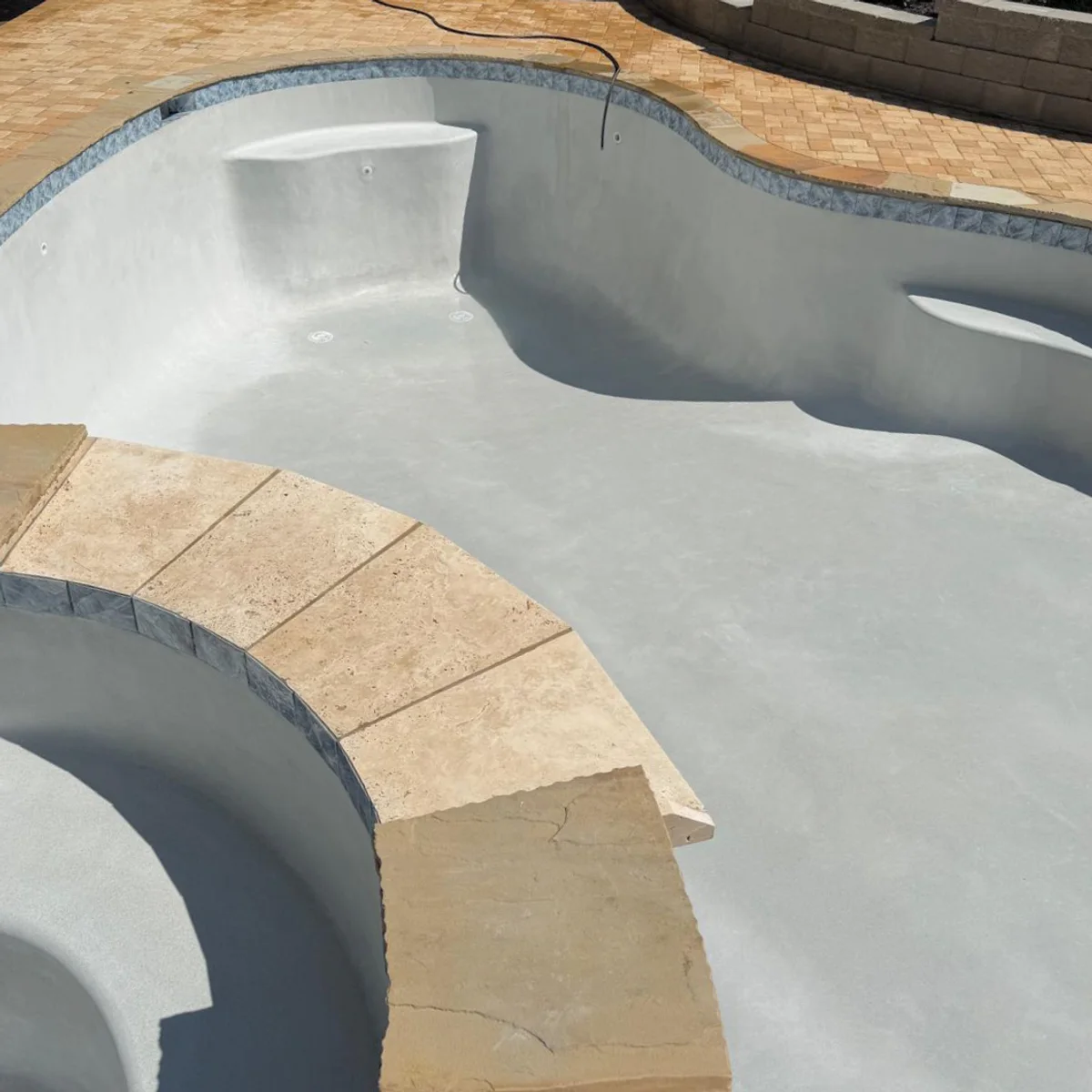
What does pool coping do?
Coping caps the bond beam, the concrete ring at the top of the pool wall, and finishes the line between the waterline tile and the deck. It is the part of the pool people hold on to, so its edge shape matters as much as its color. It also has to sit on sound concrete: HomeGuide's January 2026 pool coping guide notes that when the bond beam under old coping needs repair, that work comes first and adds to the cost.
Travertine or brick: how do they compare?
Travertine is a natural stone with a light, warm color range that suits most decks. Brick gives a traditional edge, and HomeGuide notes it pairs well with brick homes, patios and walkways. Both come in standard sizes and are made to published standards. The table uses specific products as market examples (MSI travertine, Pacific Clay and Pine Hall Brick); the pieces chosen for your pool come with their own spec sheets.
| Material | Common piece sizes | Thickness | Material standard | Installed cost per linear ft (HomeGuide, Jan 2026) |
|---|---|---|---|---|
| Travertine | Example: 12 x 24 in, also 16 x 24 and 6 x 12 in (MSI Tuscany Porcini) | 3 cm (about 1 1/4 in) or 2 in | ASTM C1527, exterior class: 2.5% maximum absorption, 7,500 psi minimum compressive strength (minimums as transcribed in a CTS lab test report for Durango Stone) | $55 to $80 |
| Brick | Examples: 4 x 8 in pavers (Pine Hall Brick); bullnose units about 3 1/2 x 9 or 3 1/2 x 11 1/2 in (Pacific Clay) | 2 1/4 in pavers; 2 3/16 in bullnose | ASTM C902; Pine Hall Brick's paver spec: 8,000 psi minimum, under 8% cold water absorption (Pine Hall Brick) | $45 to $65 |
How hot coping gets in the sun depends mostly on how much sunlight it reflects. The EPA names solar reflectance, the share of sunlight a surface bounces back, as the main determinant of a paving material's maximum surface temperature, notes that reflective pavements are light colored, and cites Lawrence Berkeley National Laboratory researchers' estimate that every 10% increase in solar reflectance can lower surface temperature by about 7°F. Our pool decks page covers more of the numbers. We bring samples to the site so you can see and touch each option in your own sun.
Which coping edge profile should you pick?
- Bullnose: a fully rounded front edge. HomeGuide calls it smooth to the touch, safer for children and easier to grip when getting in and out. MSI's travertine coping, for example, is made with one 24-inch side in full bullnose.
- Square edge: a flat top with a 90-degree corner for a cleaner, modern line. HomeGuide notes square edges cost less than rounded profiles.
- Flat coping: sits level with the deck so coping and deck read as one surface.
- Thickness: a 2-inch piece (about 5 cm) is about 2 cm thicker than a 3 cm piece of the same stone, so the edge reads thicker.
How much does pool coping cost, and how long does it last?
HomeGuide puts pool coping at $40 to $80 per linear foot installed and says replacing coping costs more than installing it new, because the old coping has to come off and be hauled away. A small plunge pool may need about 40 linear feet of coping and a large freeform pool 150 feet or more. HomeGuide also puts the life of quality coping at 10 to 30 years, with natural stone able to pass 30 years with care. These are national references, not our price. The real figure depends on the perimeter and shape of the pool, the material and the condition of the bond beam, and it comes out of the site visit and a written estimate.
How is pool coping replaced?
- Remove the old coping and its mortar bed. The waterline tile sits right below, so the top course of tile should be checked at the same time, and both planned together when it makes sense.
- Check the bond beam and repair loose or damaged concrete before anything new goes on.
- Set the new coping on a mortar bed, keeping the overhang and the joints even, then point the joints between pieces.
- Seal the joint to the deck with a flexible sealant (see below).
- Seal the stone or brick, following the sealer maker's timing.
HomeGuide says most coping replacements take 3 to 7 days, with simple rectangular pools at the short end and curved natural stone jobs taking a week or longer.
Why does the joint between coping and deck matter?
The coping sits on the pool shell and the deck sits on the ground, and both move with heat and moisture, so the joint between them is sealed with a flexible sealant made for joints that move, not with grout. W. R. Meadows, which makes the Deck-O-Seal sealants sold for pool decks, calls for a joint at least 1/4 inch and at most 1 inch wide, a sealant depth between 1/4 and 1/2 inch at about a 2:1 width-to-depth ratio, and a fully cured substrate, which it puts at the industry standard of 28 days for concrete. Angi's tile and coping guide suggests recaulking that joint about every five years, because a failed joint lets damage reach the coping and then the tile.
Does coping need sealing, and what about salt pools?
For both materials we install, yes. HomeGuide notes that travertine is porous and needs regular sealing against stains and algae, and that brick needs sealing to limit water absorption and staining. National Pool Tile's care guide lists natural stone and masonry coping among the materials that benefit from a quality sealer. If your pool runs on a salt chlorine generator, Hayward's owner's manuals advise talking to a stone installation specialist about the type, installation, sealant and upkeep of natural stone coping and decking around a salt pool.
What should Gulf Coast owners know about coping?
Pensacola gets 68.31 inches of rain in a normal year at its airport station, according to NOAA's 1991 to 2020 climate normals. With that much rain, coping spends a lot of time wet, so keeping the stone or brick sealed and the coping-to-deck joint intact is worth the upkeep.
Should coping be planned with the tile and deck?
Coping, waterline tile and deck meet at the edge of the pool, so planning them together keeps joints aligned and avoids patching between old and new materials; a full pool renovation handles all of it in one project. For more, read what pool coping is, our pool coping materials comparison and what replacing pool coping involves. Before any work we visit the pool and give you a written estimate; you can request a visit here.