Resurfacing · · 7 min read
How Long Does Pool Plaster Last? Lifespan by Finish Type
White pool plaster lasts about 7 to 12 years per HomeGuide, quartz 10 to 15 and pebble 15 to 20+. See what shortens a finish's life and how to extend it.
By Outdoor Hardscapes Pool Finishes, pool finishing contractor in Pensacola, FL.
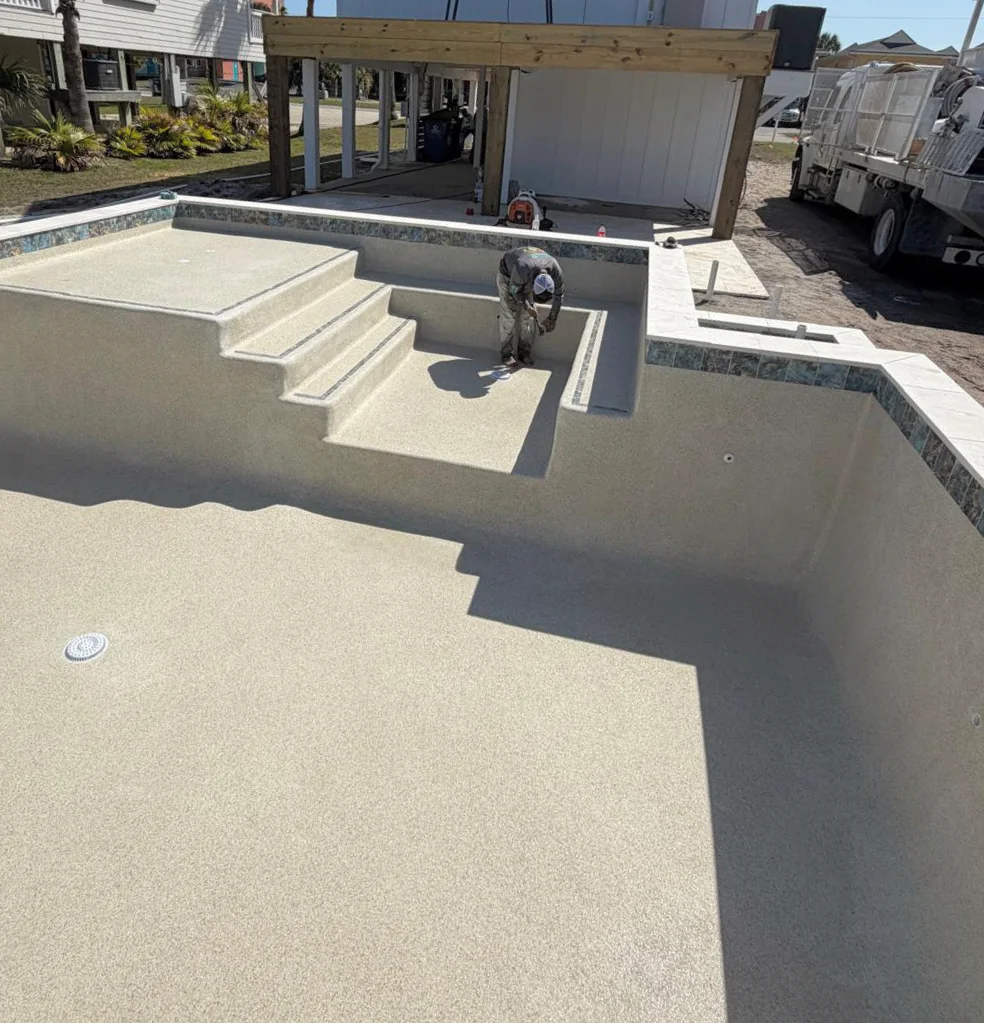
Standard white pool plaster lasts about 7 to 12 years, according to HomeGuide’s April 2025 cost guide, while the National Plasterers Council (NPC) rates traditional white plaster as a 5 to 8 year surface on its pool resurfacing page. Both sources put quartz at 10 to 15 years; for pebble, the NPC page says 12 to 18 years and HomeGuide says 15 to 20 or more. The NPC’s FAQ page adds a different figure: pool plaster can last up to 20 years with proper care.
In other words, the finish you choose sets the range, and the way the water is kept decides where in that range your pool lands. Here is what the main sources say, where their numbers differ and what you can do to stretch the life of a new finish.
How long should plaster last in a pool?
Pool plaster is a cement-based coat troweled over the concrete shell. The NPC describes standard white plaster as a simple mix of white cement, white marble aggregate and water, and calls it a relatively “soft” finish that is more sensitive to water chemistry than newer products. That helps explain why plain plaster gets the shortest rating of the cement-based finishes.
Here is how three sources rate the common finishes, each number attributed to the page that published it:
| Finish | NPC, pool resurfacing page | HomeGuide (2025) | Pebble finish manufacturer |
|---|---|---|---|
| Traditional white plaster | 5 to 8 years | 7 to 12 years | 5 to 10 years (Pebble Technology International) |
| Polished finish | 8 to 12 years | Not listed | Not listed |
| Quartz | 10 to 15 years | 10 to 15 years | 7 to 15 years (Pebble Technology International) |
| Pebble | 12 to 18 years | 15 to 20+ years | Over 20 years with proper care (Pebble Technology International) |
| Full tile | Not rated | Longest lasting, no figure given | Not listed |
Sources: NPC, Swimming Pool Resurfacing; HomeGuide, Pool Resurfacing Cost (April 25, 2025); Pebble Technology International, How Long Does a Pebble Pool Finish Last? Pebble Technology International makes pebble finishes, so its plaster and quartz figures describe competing finish types and its pebble figure describes its own kind of product.
The sources do not agree, and the NPC’s own pages do not either: the 5 to 8 years in the table comes from its resurfacing page, while its FAQ page says plaster can last up to 20 years with proper care. Each number belongs to the page that published it, and no source gives a single figure for every pool. For planning, it is safer to budget around the shorter end of each range.
Why do some pool finishes last longer than others?
The difference comes down to what the finish is made of and how it reacts to water.
- Quartz. The NPC says colored ceramic quartz aggregate creates a much more durable surface than standard plaster, one that is harder and far more resistant to fluctuating chemical conditions. Our quartz pool plaster page covers the Quartz series we apply.
- Pebble. The NPC calls pebble the most durable surface available, because river pebbles are chemically inert and unlikely to react with pool water. It also notes that pebble is more textured, costs more and can still be damaged under extreme chemical conditions.
- Additives. Plaster can be upgraded with admixtures. The NPC says pozzolan-based products lock up calcium hydroxide, the weakest element in plaster, and have been proven to reduce etching, cracking and mottling. They add cost and are not fool-proof.
What is the longest lasting pool resurfacing?
Among cement-based finishes, pebble gets the longest rating in every column of the table above. HomeGuide calls full tile the most durable and longest-lasting option of all, but it is also the most expensive at $8 to $30 or more per square foot, compared with $7 to $15 for pebble. HomeGuide suggests a tile border at the waterline with plaster below as a way to get some of the look of tile without the full cost.
Pebble also comes in different stone sizes, and smaller stones feel smoother. Pebble Technology International, for example, says its PebbleSheen line uses smaller pebbles for a smoother texture. The pebble finishes we apply are Mini Pebble, Mini Pebble with glass and regular Pebble, including StoneScapes finishes, and the pebble pool finish page covers those options.
How long does a pebble finish last in a pool?
The NPC’s pool resurfacing page rates pebble as a 12 to 18 year surface. HomeGuide puts it at 15 to 20 years or more. Pebble Technology International, the manufacturer of PebbleTec, says a properly installed pebble finish lasts over 20 years with proper maintenance and pool chemistry; that is a manufacturer’s claim, not an independent rating.
Two notes from the manufacturer are worth knowing before you judge a pebble pool. It is normal for some pebbles to come loose during the initial cure and for a small number to loosen over the years. If the water is not kept balanced, the cement around the stones can weaken and pebbles can come loose in larger amounts. In other words, pebble buys you time, but it does not make water care optional.
What shortens the life of pool plaster?
The NPC is direct about the main cause: a cement-based finish’s life expectancy “can be severely reduced” when the water is left in an aggressive condition for long periods. Aggressive water is water outside balanced ranges, including water with low calcium hardness, low pH, low carbonate alkalinity or a mix of these. It dissolves parts of the cement matrix and shows up as etching.
Other things that cut years off a finish:
- A rushed start-up. The NPC says a new finish is especially susceptible to staining, scaling and discoloration in the first 28 days. Our guide to new pool plaster start-up covers that period.
- Leaving the pool empty. The NPC says the finish should remain fully under water during its service life, except for limited servicing or repair.
- The wrong fill water. The NPC advises against filling with soft water or reverse osmosis water, and its White Paper 7 (August 2025) recommends fill water above 200 ppm calcium hardness.
- Weather. Pebble Technology International lists harsh sunlight, heavy rainfall and fluctuating temperatures among the environmental factors that affect a finish’s durability.
That last point matters on the Gulf Coast. The National Weather Service in Mobile reports that Pensacola received 60.68 inches of rain in 2025, and that total was still 7.63 inches below normal. A heavy rain adds a lot of fresh water to a pool in a short time, so retesting after a storm is a simple habit that protects the finish.
How do you keep a pool finish balanced?
The NPC recommends using the saturation index (LSI) to judge whether water is balanced, and it sets a tighter target than the general industry range. These are the numbers it publishes:
| What to watch | National Plasterers Council guidance |
|---|---|
| Saturation index (LSI) target | 0.0 to +0.3 (APSP calls -0.3 to +0.5 acceptable) |
| pH, total alkalinity, free and total chlorine | Test 1 to 2 times a week |
| Calcium hardness, cyanuric acid, total dissolved solids | Test once a month |
| Start-up care after a new finish | First 28 days |
| Pool heater after filling a new finish | Keep off for 28 days |
Sources: NPC, Swimming Pool Interior Finishes and Chemical Etching Deterioration; NPC, Tips on Filling the Pool and Initial Start Up.
Low calcium hardness is one of the conditions the NPC links to etching. Our guide to calcium hardness for plaster pools explains how it fits into the LSI. Chemicals should always be handled according to the label and safety data sheet, and a pool professional can help if the numbers will not settle.
How long does pool resurfacing last overall?
HomeGuide’s rule of thumb is to resurface every 7 to 15 years, depending on the finish. The NPC lists proper initial and ongoing water chemistry, brushing the surface, a good pool cleaning system and regular equipment maintenance as vital to reaching a finish’s anticipated lifespan.
So the honest answer is a range you influence. A well-kept quartz or pebble finish can outlast a neglected one by many years, and a plaster pool that has been balanced since day one has a better chance of reaching the longer figures above. When the finish does wear out, our pool resurfacing cost guide shows what the next one costs, and our pool resurfacing page walks through the resurfacing process on a concrete pool.
If you are in Pensacola, Alabama or the Mississippi Gulf Coast and want a second opinion on your pool, request an estimate.
Sources
- Swimming Pool Resurfacing, National Plasterers Council, accessed November 25, 2026.
- Pool Plaster FAQ, National Plasterers Council, accessed November 25, 2026.
- How Do You Choose the Proper Pool Finish?, National Plasterers Council, accessed November 25, 2026.
- Swimming Pool Interior Finishes and Chemical Etching Deterioration, National Plasterers Council, accessed November 25, 2026.
- Tips on Filling the Pool and Initial Start Up, National Plasterers Council, accessed November 25, 2026.
- How much does pool resurfacing cost?, HomeGuide, accessed November 25, 2026.
- How Long Does a Pebble Pool Finish Last?, Pebble Technology International, accessed November 25, 2026.
- December 2025 Climate Summaries, Mobile/Pensacola, National Weather Service Mobile, accessed November 25, 2026.