Pool care · · 9 min read
New Pool Plaster Startup: The 28-Day Schedule, Day by Day
New plaster needs a 28-day startup: brush twice a day, keep alkalinity at 80 to 100 ppm and wait 48 hours for chlorine. Here is the NPC schedule by day.
By Outdoor Hardscapes Pool Finishes, pool finishing contractor in Pensacola, FL.
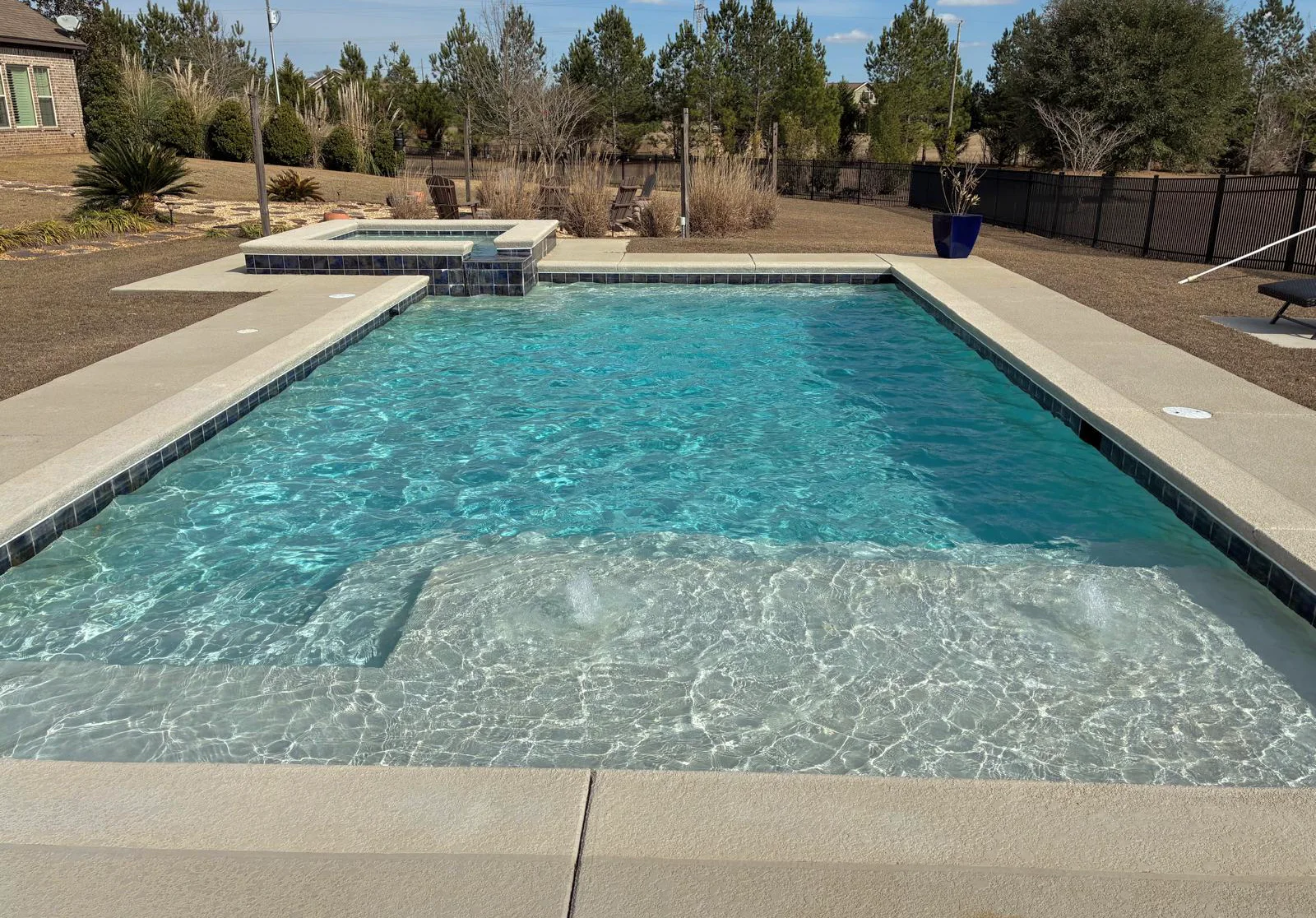
A new plaster finish needs a 28-day startup, and the first week matters most. The most recent guidance from the National Plasterers Council (NPC) comes in two 2025 white papers: White Paper 6, “Tips on Filling the Pool and Initial Start Up,” which still recommends the NPC start-up card for the day-by-day steps, and White Paper 7, on avoiding soft fill water. That earlier card (REV 03-2021) has the whole surface brushed at least twice a day, the filter running nonstop for at least 72 hours, total alkalinity held at 80 to 100 ppm and pH at 7.2 to 7.6, and no chlorine for the first 48 hours. Where the card and the 2025 papers differ, on the pool heater, on wheeled cleaners and on fill water low in calcium, the 2025 papers are the newer guidance. The card and White Paper 6 both say the finish is especially susceptible to staining, scaling and discoloration during those 28 days.
Why does new pool plaster need a startup?
Plaster is cement, and cement keeps reacting with water after the pool is full. NPT, a finish maker that publishes the NPC procedure, says 86% of the cement in plaster cures within the first 28 days. A PoolPro Magazine article on the NPC procedure gives a lower figure: hydration only 60 to 70% complete 30 days after the fill. The two differ on the number, but both describe curing that is unfinished when the startup ends. Meanwhile the surface releases calcium hydroxide, the white “plaster dust” that clouds the water and keeps shifting its chemistry.
That compound is also the weak link. NPC Technical Bulletin 3 says calcium hydroxide makes up about 24 to 27% of fully hydrated white cement and is its most soluble compound, so it is the first thing unbalanced water pulls out. The PoolPro article adds that a new finish is soft and prone to discoloration and scaling in its first weeks.
What happens on fill day?
NPC’s 2025 white paper on filling and initial start-up says the finish should be under water as soon as practical, because a late fill can increase shrinkage cracking or let the finish debond from the shell. The main fill rules:
- Fill with clean potable water, nonstop and as fast as possible, to the middle of the skimmer. Stopping can leave a “bowl ring” at the level where the water paused. NPT says a fill can take 18 to 36 hours.
- Put a clean cloth on the hose end and lay it at the deepest point. A water truck needs a cushion of at least 24 inches of water first.
- Keep sprinklers, roof runoff and other outside water off the finish until the pool is full, to prevent streaks and spots.
- Keep people and pets out while it fills.
- Test the fill water for pH, total alkalinity, calcium hardness and metals, and start the filter as soon as the pool is full to the middle of the skimmer.
What are the first chemicals to put in a new pool?
On the NPC schedule, alkalinity and pH come first, calcium follows, and chlorine waits until day 3. The card warns never to add calcium chloride and sodium bicarbonate at the same time; the PoolPro article explains that the two can react to form calcium carbonate, which clouds the water and scales the new plaster.
| Day | Total alkalinity (ppm) | pH | Calcium hardness (ppm) | Chlorine (ppm) | Also on this day |
|---|---|---|---|---|---|
| Fill day | Test only | Test only | Test only | None | Start the filter once the pool is full to mid-skimmer |
| Day 1 | 80 to 100 | 7.2 to 7.6 | Raise to 80 to 100 if low | None | Brush twice, filter runs nonstop |
| Day 2 | 80 to 100 | 7.2 to 7.6 | Raise to 100 to 150 | None | Brush twice |
| Day 3 | 80 to 100 | 7.2 to 7.6 | 100 to 150 | Add to 1.5 to 3.0 | Brush twice, no salt for 30 days |
| Days 4 to 7 | 80 to 100 | 7.2 to 7.6 | Raise slowly to at least 200 | Maintain | Begin stabilizer (CYA) toward 30 to 50 ppm |
| Days 7 to 28 | Keep in range | Keep in range | 200 or more | Maintain | Brush when adding chemicals or after debris |
| After day 28 | 80 to 120 (carbonate alkalinity) | 7.2 to 7.6 | 200 to 400 | 1 to 3 (free chlorine) | Keep the LSI between 0.0 and +0.3 |
Source: NPC start-up card, REV 03-2021, the day-by-day schedule that NPC’s White Paper 6 (2025) still recommends. Carbonate alkalinity is total alkalinity minus one third of the cyanuric acid reading. For low-calcium fill water, the newer guidance is NPC’s White Paper 7 (August 2025): above 200 ppm from the start, raised as the pool fills, instead of this slow climb.
The adjustments use muriatic acid, baking soda, calcium chloride and chlorine. The card says to always add a chemical to water, never the reverse, to pre-dilute where possible, and to add calcium chloride in 10-pound doses several hours apart. Acid and chlorine are hazardous products: read the label and the safety data sheet, and leave the dosing to your plastering company or a trained start-up technician. The NPC runs a start-up certification class and lists certified technicians on its website.
How do I brush new pool plaster?
Brushing keeps plaster dust from settling into the surface as a stain. What the sources say:
- How often: at least twice a day through the first week, and after every chemical addition.
- How: NPT says to brush from the top of the walls down, starting at the shallow end and finishing at the deep end. PoolPro advises nylon bristle brushes while the finish is new and soft.
- Cleaners: NPC’s newer White Paper 6 (2025) says wheeled vacuums can go in once the water is chemically balanced and no plaster dust remains, typically 7 to 10 days after the fill, or as the finish maker directs. The earlier 2021 card said no wheeled cleaners for 28 days. NPT also lists robotic cleaners, salt chlorine generators and most chemical feeders as equipment to hold until after day 28.
- When it tapers off: on day 7, any remaining dust comes out with a brush vacuum. After that, the card limits brushing to visible debris and chemical additions, and the NPC recommends weekly brushing for the life of the finish.
How long does it take for a newly plastered pool to cure?
Curing continues past day 28. The NPC says cement-based finishes keep hydrating under water and gain a significant share of their final strength during the first three months. Its start-up card also asks you to keep the Langelier Saturation Index (LSI), a single number that combines pH, alkalinity, calcium, temperature and dissolved solids, between 0.0 and +0.3, “especially within the first six months.” A negative LSI etches the surface; a positive one scales and stains it.
Are hairline cracks in new pool plaster normal?
Often, yes. The NPC explains that all hardened plaster contains microscopic shrinkage cracks. When the surface gets wet before the pool is full, water soaks into them faster than into the rest of the finish, and a “road map” of fine lines shows up. These are called check cracks, or closed shrinkage cracks, and the NPC says they seal themselves with cement hydration material within about 24 hours of being fully under water.
The NPC’s rule of thumb is simple: report any crack that is still open 24 hours after the pool is full to the pool builder or plastering company. Open shrinkage cracks usually trace back to water loss during application, such as high heat, wind, low humidity or a delayed fill, and they need patching. Our guide to pool plaster problems covers crack types and repairs in more detail.
What changes for a startup on the Gulf Coast?
Three local factors matter:
- Low-mineral fill water. The U.S. Geological Survey’s 1990 ground water atlas says the sand-and-gravel aquifer, the main water source from Escambia and Santa Rosa counties in Florida to Baldwin County in Alabama, ordinarily carries less than 50 milligrams per liter of dissolved solids. That describes untreated aquifer water, not what comes out of your tap today, so test the fill water. The NPC warns that water low in hardness can leach calcium hydroxide from cement. Its White Paper 6 (2025) says not to fill with soft water or reverse osmosis water, and White Paper 7 (August 2025) recommends fill water above 200 ppm calcium hardness. If yours tests lower, it lists options such as dosing calcium chloride during the fill or trucked water; ask your plasterer which fits your finish.
- Heat. NOAA’s 1991 to 2020 normals put Pensacola’s average daily high at 91.6°F in July. On the NPC card’s LSI table, the temperature factor climbs from 0.6 at 76°F to 0.8 at 94°F, so the same water leans toward scaling in summer. Retest more often in hot weather, and keep the heater off for 28 days (White Paper 6).
- Summer storms. Pensacola averages 7.89 inches of rain in July (NOAA). Keep roof and deck runoff away from the pool during the fill, since outside water on an unfilled finish causes streaks.
Who is responsible for the startup?
Decide this before the fill. NPC’s white paper says the plastering company typically starts the water, and that it is important to determine who will turn it off and who will perform the start-up. NPT notes that the startup is normally the remodeling company’s or builder’s job and that following the guidelines is needed to keep the finish warranty.
The NPC card is common trade practice, not the only method. White Paper 6 says other start-up procedures produce similar good results, and that proprietary finishes, such as many quartz and pebble finishes, should follow the manufacturer’s instructions. A contract with your builder or plasterer overrides NPC recommendations, so ask for the schedule in writing.
How do I maintain new pool plaster after day 28?
After day 28, switch to the NPC’s ongoing ranges: free chlorine 1 to 3 ppm, pH 7.2 to 7.6, carbonate alkalinity 80 to 120 ppm, calcium hardness 200 to 400 ppm, cyanuric acid 30 to 50 ppm and an LSI of 0.0 to +0.3. NPC Technical Bulletin 3 suggests testing pH, alkalinity and chlorine once or twice a week, and calcium, stabilizer and dissolved solids once a month. The card warns that cyanuric acid at 100 ppm and above may permanently damage the surface. Our article on calcium hardness for plaster pools explains how to keep calcium where plaster needs it.
Planning a new interior? Our quartz pool plaster page covers the Quartz series we apply, and our pool resurfacing page walks through the resurfacing process; every job starts with a site visit and a written estimate.
If you are in Pensacola, Alabama or the Mississippi Gulf Coast and want a second opinion on your pool, request an estimate.
Sources
- NPC Pool Start-up Card (REV 03-2021), National Plasterers Council (hosted by NPT), accessed November 25, 2026.
- White Paper 6: Tips on Filling the Pool and Initial Start Up (2025), National Plasterers Council, accessed November 25, 2026.
- Frequently Asked Questions (previously published NPC guidance), National Plasterers Council, accessed November 25, 2026.
- Technical Bulletin Number 3: Swimming Pool Interior Finishes and Chemical Etching Deterioration, National Plasterers Council, accessed November 25, 2026.
- Swimming Pool Start-Up Procedures from National Plasters Council, NPT, accessed November 25, 2026.
- The NPC Start-up Procedure, PoolPro Magazine, accessed November 25, 2026.
- Ground Water Atlas of the United States, HA 730-G (1990): Sand and Gravel Aquifer, U.S. Geological Survey, accessed November 25, 2026.
- Summary of Monthly Normals, 1991 to 2020: Pensacola Regional Airport, NOAA National Centers for Environmental Information, accessed November 25, 2026.