Decks · · 7 min read
Pool Deck Ideas: 10 Ways to Plan a Cooler, Better-Draining Deck
Pool deck ideas for paver and travertine decks: cooler colors, drainage slopes, walkway width and $3,200 to $12,000 for a 20x20 deck at HomeGuide rates.
By Outdoor Hardscapes Pool Finishes, pool finishing contractor in Pensacola, FL.
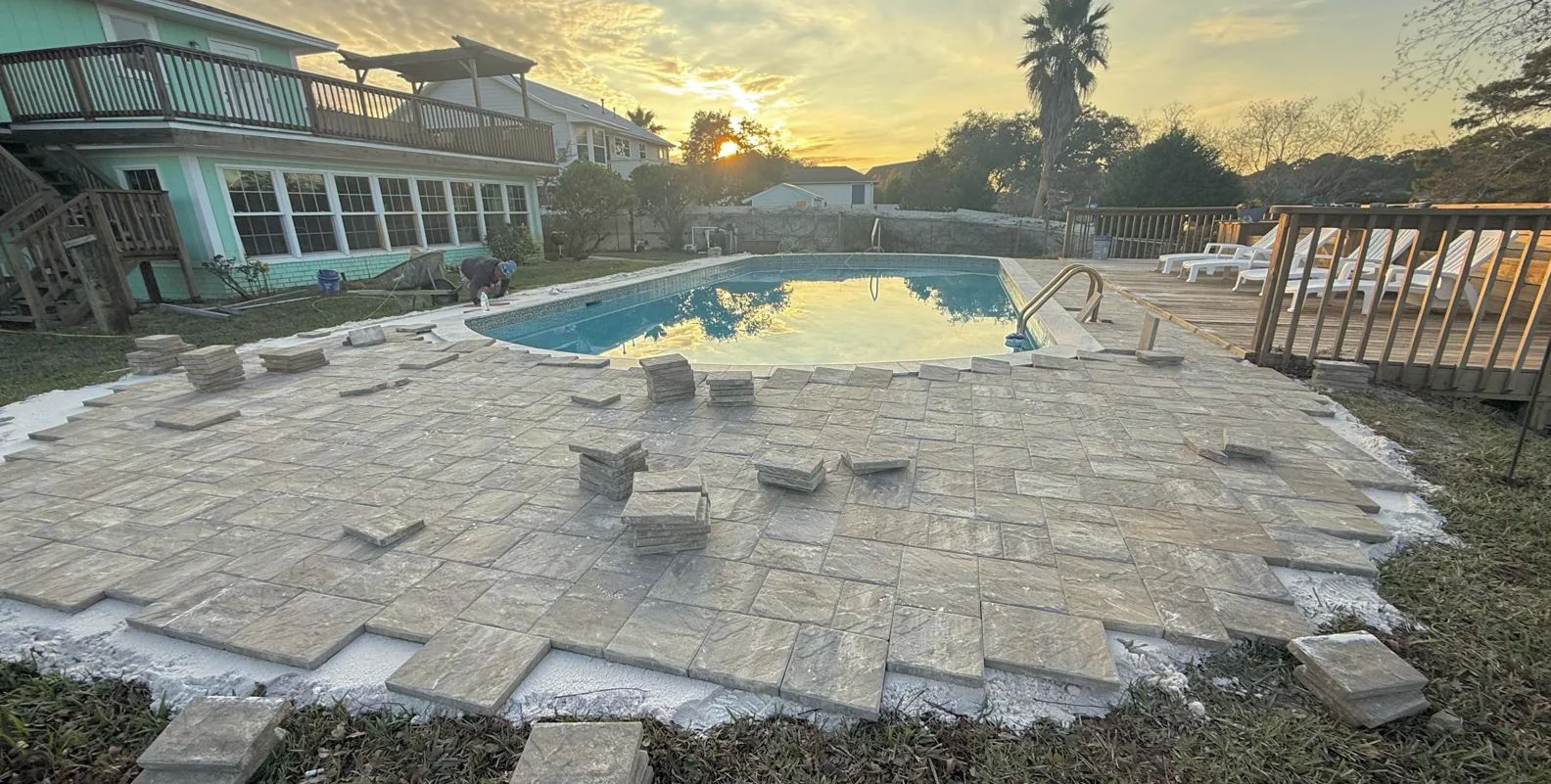
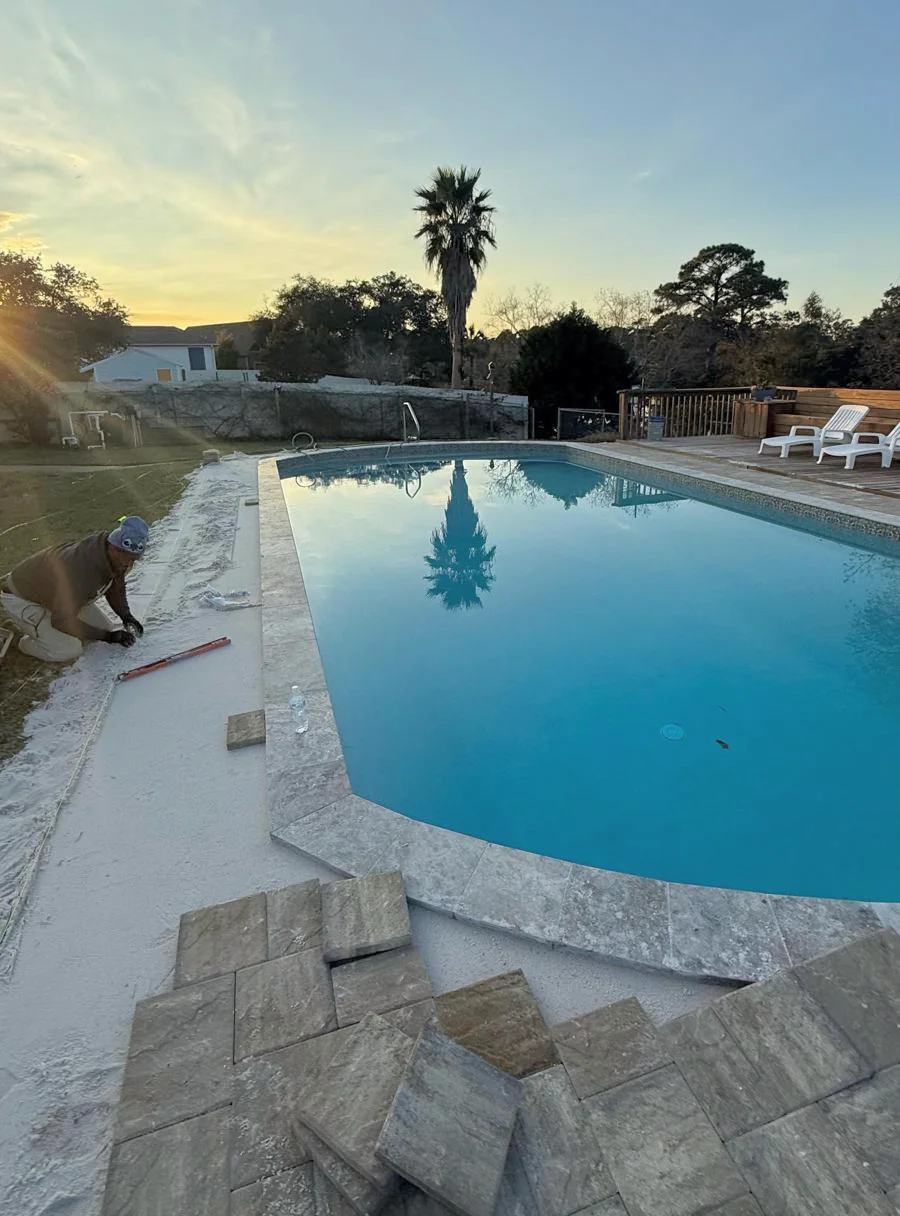
The pool deck ideas that matter most on the Gulf Coast come down to color, drainage and space. Light surfaces stay cooler: River Pools measured six patio materials on a 99°F day and concluded that patio temperature “is more a consequence of color than the actual material.” Water has to leave fast too, because Pensacola averages 68.31 inches of rain a year, per the Florida Climate Center’s 1991 to 2020 normals.
Below are ten paver and travertine ideas built around those facts, followed by sizing and cost numbers. We build paver and travertine pool decks, so every idea here is one we can talk through on a site visit.
What pool deck ideas work best with pavers and travertine?
1. Match the coping to the deck
The coping is the cap on the pool wall, and it meets the deck all the way around. Using the same travertine for both makes the edge and the deck read as one surface. For contrast, pair brick coping with a lighter paver field. Either way, plan the coping and the deck together so the joints line up. Our comparison of pool coping materials covers the options.
2. Use a French pattern for travertine
The French, or Versailles, pattern mixes four paver sizes into a random-looking layout. HomeGuide calls it the most popular pattern for travertine and says it adds $1 to $3 per square foot in labor compared with a simple running bond.
3. Frame the deck with a border
A border row around the field gives the deck a finished outline and a clean line against the lawn or planting beds. HomeGuide prices custom designs with borders at $2 to $5 per square foot of extra labor, and herringbone at $1 to $2.
4. Keep the light colors where bare feet go
Color drives surface heat more than the material does, which is the lesson River Pools drew from its test. Use the lightest blend along the pool and on walkways, and save darker accents for borders, planters or areas under shade.
5. Build the slope in from day one
The 2024 International Swimming Pool and Spa Code (ISPSC) requires decks to slope away from the pool or toward deck drains. For travertine and brick-set pavers at residential pools, its minimum slope is 1/8 inch per foot, and no deck may slope more than 1/2 inch per foot. The Concrete Masonry and Hardscapes Association (CMHA), which formed when the Interlocking Concrete Pavement Institute merged with the National Concrete Masonry Association, recommends paver slopes of at least 1.5%, a little under 3/16 inch per foot. Over a 10 foot deck, that means roughly 1.25 to 1.8 inches of fall away from the water. The ISPSC is a model code that applies only where your state or local government has adopted it, sometimes with changes, so confirm the required slope with your local building department before the base goes in.
6. Plan drainage for heavy rain
With about 68 inches of rain a year, slope alone is not always enough. The ISPSC allows deck drains at the back of the coping where the site requires them, and it requires site and roof drainage to be directed away from the pool area. Look at where your gutters, lawn and neighbors’ yards send water before you finalize the layout.
7. Start with a solid base
A paver or travertine deck is only as good as what is under it. CMHA says patios and pedestrian areas need a compacted base at least 4 inches thick over well-drained soil, with a bedding sand layer screeded to about 1 inch. HomeGuide calls skimping on base preparation the most common cause of paver settling and failure. The pavers themselves need enough thickness too. CMHA says pedestrian areas and driveways are paved with concrete units 2 3/8 inches (60 mm) thick, and HomeGuide lists 1.25 inch travertine as the standard for patios, walkways and pool decks, with thicker 2 to 3 inch pieces reserved for driveways.
8. Leave room to walk and room to lounge
Plan a clear walkway around the pool and a wider zone where chairs go. The CDC’s 2024 Model Aquatic Health Code (5th edition), voluntary guidance written for public pools, calls for a perimeter deck at least 4 feet wide. It does not apply to private backyard pools, but it is a useful benchmark for a walkway.
9. Choose for sun and salt
Strong sun is a given here, and a salt system adds one more thing to plan for. If your pool uses one, read our guide to travertine vs pavers for a pool deck before you choose stone, since sealing timing matters.
10. Design for easy repairs
Pavers and travertine are laid as separate pieces, so a cracked or stained piece can be lifted and replaced. HomeGuide puts individual travertine paver replacement at $10 to $50 per paver. Keep a few spare pieces from the same batch, since natural stone varies from lot to lot.
What pool deck material stays cool in the sun?
A light-colored one. HomeGuide’s 2026 travertine guide says travertine stays 20% to 30% cooler than concrete in direct sunlight. River Pools, which measured textured concrete, gray and earth-tone pavers, bluestone and cream and beige travertine on a 99°F day, put the weight on color instead: its conclusion is that patio temperature depends more on color than on the material. So a light concrete paver can come close to light travertine, and a dark stone of any kind will run hotter.
That matters here. Pensacola’s normal July high is 91.6°F, according to the Florida Climate Center, so a pool deck spends months in strong afternoon sun. Pick the lightest color you like in either material, choose a textured finish that grips when wet, and add shade where people sit.
How wide should a pool deck be?
The 2024 ISPSC deck section we checked sets no minimum deck width for backyard pools, so the answer depends on how you use the space. A good starting point is a clear walkway of at least 4 feet, the minimum the CDC’s Model Aquatic Health Code recommends for public pool perimeter decks; it is guidance for public pools, not a rule for yours. Then widen the deck where you want lounge chairs, a table or a grill.
HomeGuide notes that many pool decks are proportionate, meaning they have about the same square footage as the pool. A 15 by 30 foot pool, at 450 square feet of water, would have roughly 450 square feet of deck under that rule of thumb. Lot lines, setbacks, fences and local permits may limit what you can build, so check with your building department.
How much does a 20x20 pool deck cost?
A 20 by 20 foot deck is 400 square feet. Multiplying national installed ranges from HomeGuide by that area gives these estimates (our arithmetic, not quotes):
| Material | Installed cost per sq ft | Estimate for 400 sq ft (20 x 20) | Source |
|---|---|---|---|
| Poured concrete patio | $5 to $15 | $2,000 to $6,000 | HomeGuide (December 2025) |
| Paver patio | $10 to $17 | $4,000 to $6,800 | HomeGuide (December 2025) |
| Concrete pavers | $8 to $20 | $3,200 to $8,000 | HomeGuide (April 2026) |
| Travertine pool deck | $13 to $30 | $5,200 to $12,000 | HomeGuide (April 2026) |
Two notes on those numbers. First, HomeGuide says replacing an existing pool deck costs about $5 per square foot more than building new, because the old deck has to be removed and hauled away, which adds about $2,000 on 400 square feet. Second, these are national reference ranges, not our prices. Pattern, border, access, drainage work and the shape of the pool all change the total, and the real number comes from a site visit and a written estimate.
If the deck is part of a bigger update, our guide to pool remodel cost shows how the deck fits next to tile, coping and a new finish, and a full pool renovation can handle them in one project. For the deck itself, see our pool deck service.
If you are in Pensacola, Alabama or the Mississippi Gulf Coast and want a second opinion on your pool, request an estimate.
Sources
- How Hot Do Swimming Pool Patios Get? Temperature Comparison, River Pools and Spas, accessed November 25, 2026.
- Pensacola 1991 to 2020 Normals, Florida Climate Center, accessed November 25, 2026.
- 2024 International Swimming Pool and Spa Code, Chapter 3: General Compliance, International Code Council, accessed November 25, 2026.
- PAV-TEC-002: Construction of Interlocking Concrete Pavements, Concrete Masonry and Hardscapes Association, accessed November 25, 2026.
- 2024 Model Aquatic Health Code, Code Language (5th Edition), Centers for Disease Control and Prevention, accessed November 25, 2026.
- How Much Do Travertine Pavers Cost? (2026), HomeGuide, accessed November 25, 2026.
- How Much Does a Pool Deck Cost? (2026), HomeGuide, accessed November 25, 2026.