Decks · · 6 min read
Travertine vs Pavers for a Pool Deck: Cost, Heat and Care
Travertine vs pavers for a pool deck: 2026 costs of $13 to $30 vs $8 to $20 per sq ft, a 99°F heat test, water absorption limits and sealing needs.
By Outdoor Hardscapes Pool Finishes, pool finishing contractor in Pensacola, FL.
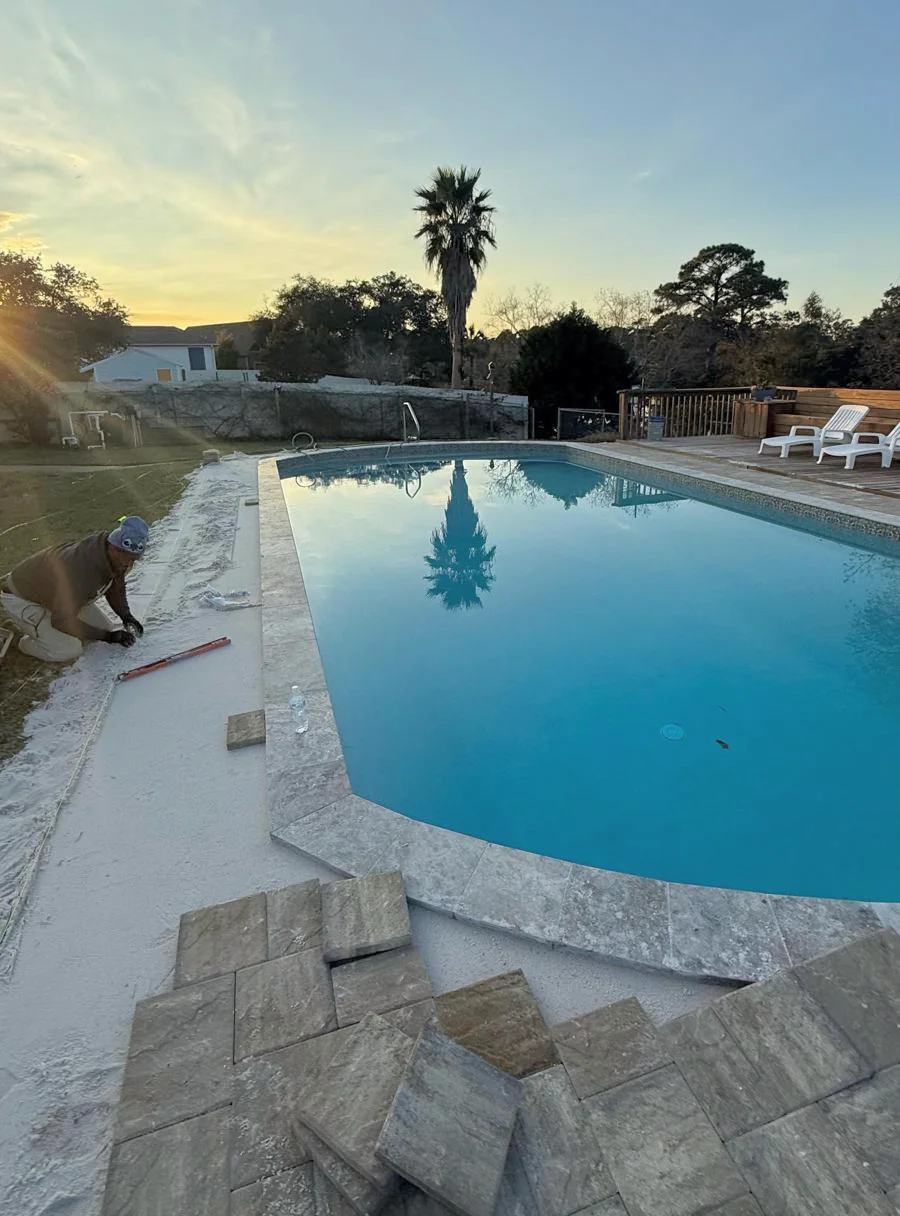
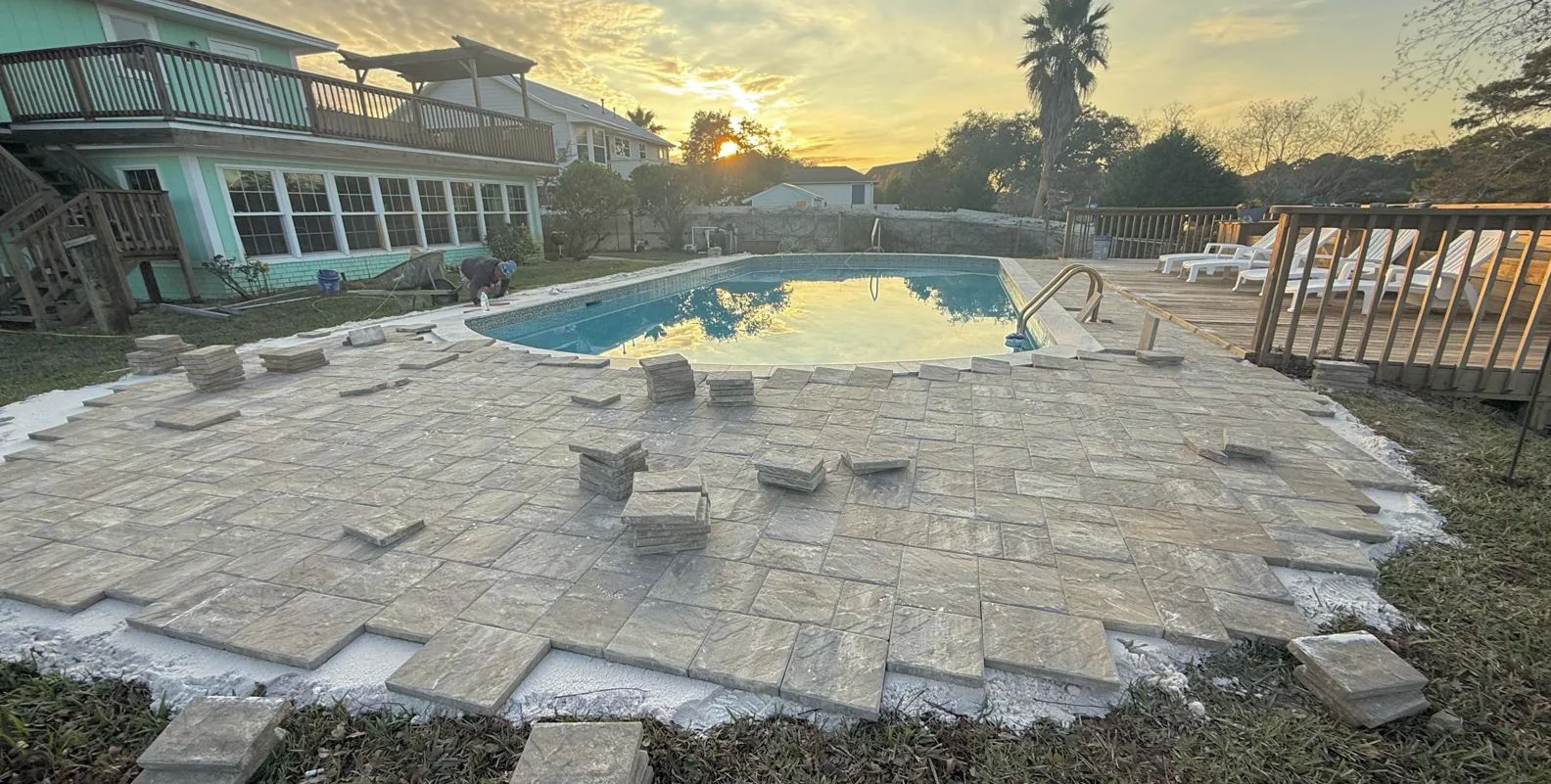
Concrete pavers are cheaper than travertine: HomeGuide’s April 2026 cost guide puts installed concrete pavers at $8 to $20 per square foot and a travertine pool deck at $13 to $30 per square foot. Travertine usually wins on comfort, but mostly because of its light color: River Pools measured six patio materials on a 99°F day in Virginia and concluded that patio temperature “is more a consequence of color than the actual material.”
We build both paver and travertine pool decks around the Gulf Coast, so this guide is not trying to sell you one over the other. It lays out the numbers so you can pick the one that fits your pool, your budget and how you use the deck.
How do travertine and pavers compare for a pool deck?
The table puts the main differences side by side. Costs are national installed ranges from cost guides, not quotes. Absorption and strength figures are the limits each material must meet under its own ASTM standard, measured with different test methods, so read them as a guide rather than a lab duel.
| Factor | Travertine pavers | Concrete pavers | Source |
|---|---|---|---|
| Installed cost, per sq ft | $13 to $30 for pool decks | $8 to $20 | HomeGuide (April 2026) |
| Installed cost, per sq ft | $15 to $27 | Not listed | Angi (October 2026) |
| Max water absorption in its standard | 2.5% by weight (ASTM maximum) | 5% average (ASTM C936) | Natural Stone Institute; CMHA |
| Min compressive strength | 7,500 psi (exterior) | 8,000 psi average | Natural Stone Institute; CMHA |
| Typical lifespan | 50 to 100+ years | 25 to 50 years | HomeGuide (April 2026) |
| Maintenance level | Moderate | Low to moderate | HomeGuide (April 2026) |
Are pavers cheaper than travertine?
Yes. HomeGuide says concrete pavers cost 30% to 50% less than travertine on average. On a 500 square foot deck, its ranges work out to about $4,000 to $10,000 for concrete pavers and $6,500 to $15,000 for a travertine pool deck. Angi’s October 2026 guide lists a 600 square foot travertine pool deck at $9,000 to $16,200 installed.
A few things move travertine to the low or high end of that range:
- Grade. HomeGuide lists commercial grade travertine, with more color variation and filled holes, at $5 to $8 per square foot for material, and select grade at $18 to $30.
- Pattern. A simple running bond adds nothing, while the popular French (Versailles) pattern adds $1 to $3 per square foot in labor, per HomeGuide.
- Region. HomeGuide notes that homeowners in the Southeast and Southwest, where travertine is common and easy to get, typically pay 10% to 20% less than in the Northeast or Pacific Northwest.
- Deck size. Larger decks cost less per square foot. HomeGuide gives $18 to $25 for a 200 square foot patio against $13 to $20 for a 1,000 square foot pool deck.
Both materials sit on the same kind of base: excavation, a compacted gravel layer and a sand bedding layer. The real price for your yard depends on access, drainage, the pool shape and the deck size, and comes from a site visit and a written estimate.
Is travertine good for a pool deck?
For most pools, yes. Its strengths line up well with how a pool deck is used:
- Comfort. The most common travertine color is classic ivory or beige, according to HomeGuide, and light colors stay cooler in the sun, which is the conclusion River Pools drew from its test.
- Grip. Tumbled and brushed finishes grip well when wet, according to HomeGuide. Polished travertine does not belong outdoors.
- Color that lasts. HomeGuide notes that travertine keeps its color because the color runs through the whole stone, while concrete pavers can fade over time.
- Repairs. A cracked or stained paver can be lifted and replaced on its own, without disturbing its neighbors.
- A matched edge. A travertine deck pairs naturally with travertine coping, so the edge and the deck read as one surface. That is a good reason to plan pool coping and pool deck work together.
Does travertine absorb water?
Yes, but less than most people expect from a stone full of holes. The Natural Stone Institute lists travertine absorption at 0.10% to 2.5% by weight, with an ASTM recommended maximum of 2.5%. Concrete pavers under ASTM C936 may absorb up to 5% on average, according to the Concrete Masonry and Hardscapes Association (CMHA), which formed when the Interlocking Concrete Pavement Institute merged with the National Concrete Masonry Association. The two standards use different test methods, so treat these as ceilings to compare loosely, not as test results for any product.
What makes travertine stain is its open surface. Natural pores and holes catch dirt, sunscreen, leaves and pool water. HomeGuide says that without sealing, travertine absorbs moisture and organic stains more readily, and it recommends a penetrating sealer every 2 to 3 years. The Natural Stone Institute also says larger holes, more than 2 cm across or running through the stone, should be filled.
What are the downsides of travertine?
Travertine is a strong choice, but it has real trade-offs:
- Higher cost. It costs more up front than concrete pavers, as shown above.
- Sealing upkeep. Plan on resealing every few years.
- Acid sensitivity. Travertine is a calcium carbonate stone. The Natural Stone Institute warns that strong acid cleaners “will burn and discolor the travertine,” so never clean it with acid, and protect it when a plaster pool gets an acid wash.
- Salt exposure. On a salt water pool, seal before salt arrives. The LATICRETE data sheet for its salt water resistant sealer says the product is not intended for surfaces already exposed to salt water and rates its expected wear at up to 5 years around salt water pools.
- Natural variation. Each piece looks a little different. HomeGuide notes that lower grades show more color variation and filled holes, and premium grades cost more for consistency.
Which stays cooler in the Gulf Coast sun?
Summer here is long and hot. Pensacola’s normal July high is 91.6°F, according to the Florida Climate Center’s 1991 to 2020 normals, and the deck sits in that sun all afternoon.
HomeGuide’s travertine guide says travertine stays 20% to 30% cooler than concrete in direct sunlight. River Pools, after measuring six materials including textured concrete, gray and earth-tone pavers and cream and beige travertine, drew a broader lesson: patio temperature “is more a consequence of color than the actual material.” So a light-colored paver can come close to light travertine, and a dark travertine will not save your feet. If heat is your main concern, choose the lightest color you like in either material, and add shade where people sit.
When do concrete pavers make more sense?
Pavers are the better fit when budget comes first, when you want a specific shape, color or modern pattern, or when the deck should match brick or pavers elsewhere in the yard. CMHA says concrete pavers made in the U.S. should meet ASTM C936, with a minimum average compressive strength of 8,000 psi, so a quality paver is a tough surface. CMHA also notes that pedestrian areas and driveways are paved with units 2 3/8 inches (60 mm) thick. Like travertine, concrete pavers are laid as separate pieces, so a damaged one can be lifted and replaced, and they come in many shapes and colors that pair well with brick coping. Pick a light blend for the pool area and the heat gap narrows.
Still deciding on a layout? Our pool deck ideas cover patterns, borders, drainage and width, and our comparison of pool coping materials helps you pick the edge that goes with your deck. If the deck is part of a larger update, a pool renovation can bring the finish, tile, coping and deck together.
If you are in Pensacola, Alabama or the Mississippi Gulf Coast and want a second opinion on your pool, request an estimate.
Sources
- How Much Do Travertine Pavers Cost? (2026), HomeGuide, accessed November 25, 2026.
- How Much Do Travertine Pavers Cost? (2026 Data), Angi, accessed November 25, 2026.
- How Hot Do Swimming Pool Patios Get? Temperature Comparison, River Pools and Spas, accessed November 25, 2026.
- Travertine (Section 12), Natural Stone Institute, accessed November 25, 2026.
- PAV-TEC-002: Construction of Interlocking Concrete Pavements, Concrete Masonry and Hardscapes Association, accessed November 25, 2026.
- STONETECH Salt Water Resistant Sealer Data Sheet (DS-288), LATICRETE, accessed November 25, 2026.
- Pensacola 1991 to 2020 Normals, Florida Climate Center, accessed November 25, 2026.