Pool care · · 8 min read
Pool Plaster Problems: Cracks, Etching, Stains and Fixes
Cracks, etching, scale, stains and delamination are the most common pool plaster problems. Causes, NPC water ranges and national repair costs from $100.
By Outdoor Hardscapes Pool Finishes, pool finishing contractor in Pensacola, FL.
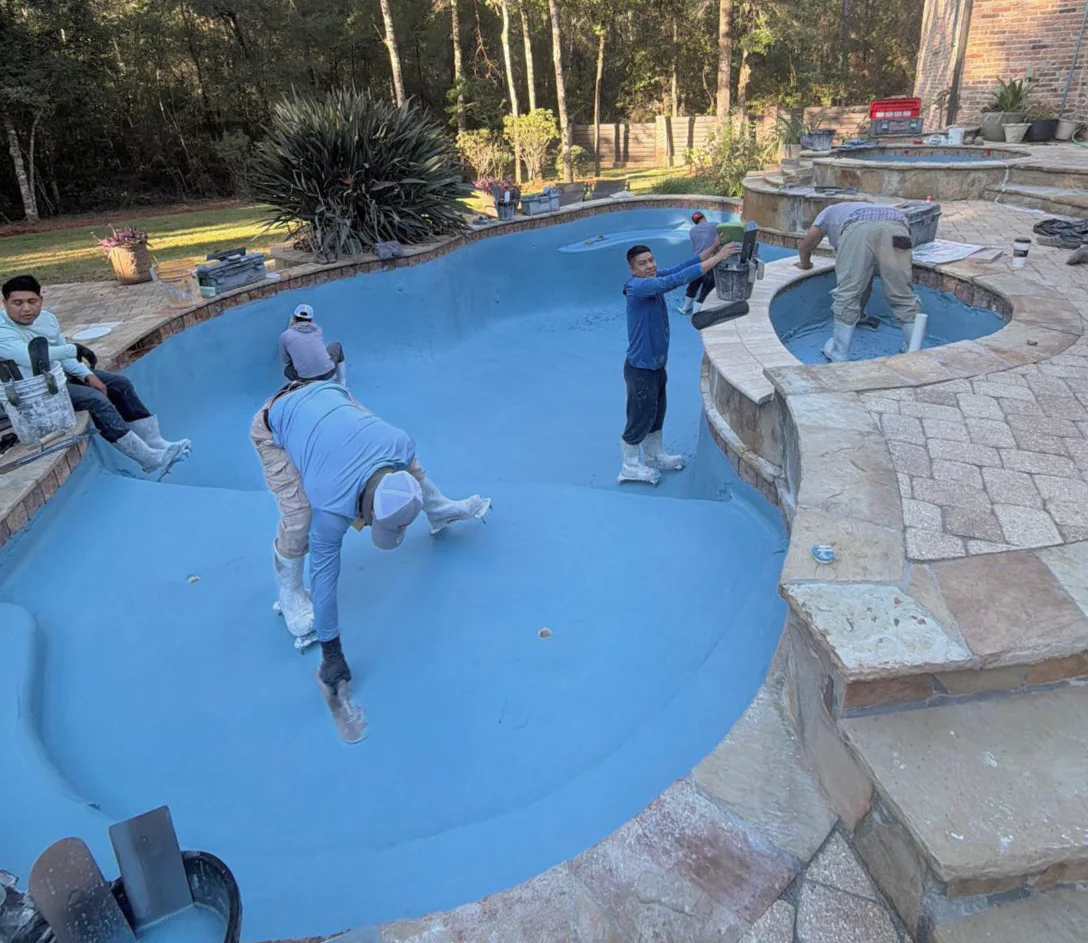
The most common pool plaster problems are cracks, etching (white spots and rough patches), scaling, stains, mottled color and bond failures such as delamination, spalls and calcium nodules. The National Plasterers Council (NPC) traces most of them to two sources: how the plaster was mixed, applied and filled, and water that drifted out of balance. National cost guide HomeGuide (2025) puts small crack repairs in a concrete pool at $100 to $200, while widespread damage usually means resurfacing at $6,000 to $15,000.
Knowing which problem you have tells you whether the answer is a patch, a water fix or a new finish.
What are the most common problems with pool plaster?
| Problem | What you see | Usual cause | Key number | Usual fix |
|---|---|---|---|---|
| Check cracks | Fine “road map” lines, mostly when the pool is drained or refilling | Normal shrinkage as plaster sets | Seal within about 24 hours under water | None, cosmetic |
| Open shrinkage cracks | Cracks still open after the fill | Water lost too fast during application: heat, wind, low humidity, late fill | Upper 1/8 inch, or through a full coat | Clean and fill with cement paste |
| Structural cracks | Cracks through the full thickness that can grow | Soil movement or shell design | Full thickness of the finish | Fix the structure, then patch |
| Etching and spot etching | White spots, rough or pitted areas | Low carbonate alkalinity, low calcium, low pH, high stabilizer | NPC ranges: carbonate alkalinity 80 to 120 ppm, stabilizer 30 to 50 ppm | Rebalance the water |
| Scaling | White or gray crust, rough to the touch | Scale-forming (positive LSI) water | NPC LSI target: 0.0 to +0.3 | Rebalance, then remove the scale |
| Metal stains | Blue, green or black (copper); brown (iron) | Fill water, corroded heater parts, copper algaecides, iron fertilizer | #80 wet/dry sandpaper test | Sand off or treat chemically |
| Mottling | Uneven light and dark patches, mostly in colored plaster | Pigment added to the plaster | None: the NPC calls it cosmetic | Usually left alone |
| Delamination, blisters, spalls | Hollow-sounding areas, small bumps, flakes that break off | Poor bond, over-troweling, finish left dry, aggressive water | Upper 1/8 inch of the finish | Remove and patch |
| Calcium nodules | Hard white bumps, often over a crack | Water carrying calcium out of voids and cracks | Can take a few years to stop growing | Sand, patch or replaster |
Sources: NPC FAQ (answers the NPC says preserve its previously published technical guidance) and NPC Technical Bulletin 3; nodule timing from Orenda.
Are hairline cracks in pool plaster normal?
Most are. The NPC says microscopic shrinkage cracks exist in all hardened plaster and concrete. When a dry surface gets wet, water soaks into them faster than into the rest of the finish, so a road map of fine lines appears. These check cracks, or closed shrinkage cracks, seal themselves with cement hydration material within about 24 hours under water, and the NPC calls them “generally nothing to worry about.” That is why a drained pool often looks more cracked than it really is.
Two kinds of cracks do need work:
- Open shrinkage cracks stay open after the fill. The NPC lists causes such as fast water loss during application in high wind, high heat or low humidity, too much water in the mix, overworking the finish and a delayed fill. Small ones are cleaned and filled with cement paste; if they are too numerous, resurfacing may be the only alternative.
- Structural movement cracks run through the full thickness and can keep growing until the movement under them stops. A surface patch on one of these is cosmetic. The structural problem has to be fixed first.
The NPC’s rule for a new or refilled pool: report any crack still open 24 hours after the fill to the builder or plastering company.
What causes white spots and rough patches?
Usually etching, which means the water dissolved part of the cement. NPC Technical Bulletin 3 says water with low calcium hardness, low carbonate alkalinity or low pH attacks the most soluble part of the plaster first, around aggregate particles and tile, and the damage often shows as small spots. The NPC names low carbonate alkalinity and elevated cyanuric acid (stabilizer) as the main contributors to “spot etching.”
The opposite problem is scaling. Water with a positive Langelier Saturation Index (LSI) deposits calcium as a white crust. NPC Technical Bulletin 3 sets the ideal LSI at 0.0 to +0.3, tighter than the 0.0 to +0.5 ideal range it attributes to APSP, a pool industry association. The NPC’s ongoing ranges are:
- pH 7.2 to 7.6
- Carbonate alkalinity 80 to 120 ppm
- Calcium hardness 200 to 400 ppm
- Cyanuric acid 30 to 50 ppm
Our guide to new pool plaster startup shows how these numbers are set in the first 28 days, when the finish is most vulnerable.
Why is my pool plaster stained or discolored?
Color changes have several sources, and the fix depends on which one you have:
- Metal stains. The NPC says blue, blue-green or black stains that appear after a year or two are usually copper or iron. Copper comes from fill water (especially well or trucked water), corrosive water attacking heater parts, poorly maintained ionizers or overdosed copper algaecides. Iron comes from metal pipes, fill water or iron-based fertilizer that blows or washes in.
- Small brown or rust spots. The NPC lists metal particles from nearby work such as wrought iron fencing, granular fertilizer, or an impurity in the finish.
- Mottling. The NPC says that whenever pigment is added to plaster, mottling and marbling will occur, and it considers this cosmetic, not structural.
How do you fix discolored pool plaster?
Start by identifying the stain. The NPC suggests rubbing it with #80 wet/dry sandpaper or a diamond hand pad: metal stains and fertilizer spots usually sand off. If a spot does not sand off, it may be an impurity in the material that needs chemical treatment, or picking out and patching by the installer. Then remove the source, whether that is metal in the fill water, a corroding heater or fertilizer near the pool, or the stain will return.
Widespread staining on a drained pool is the job of an acid wash, and our guide to pool stains by color walks through which treatment matches which stain.
What do delamination, blisters and spalls mean?
The NPC separates bond problems into a few types:
- Debonding: the finish never bonded properly to the shell or the old plaster, usually because of how the surface was prepared.
- Delamination: the finish splits within itself.
- Blisters: small round bumps where the top layer has separated but not broken off, often from trapped air or troweling past final set.
- Spalls: the top layer has lifted and broken away, from abrasion, aggressive water, or plaster left dry too long.
Blisters and spalls usually involve the top 1/8 inch of the finish. The NPC’s remedy is to remove isolated debonded areas and patch them with a bonding agent. Small blisters and spalls can sometimes be repaired under water, and visible cracks over hollow areas should be filled so water cannot leach the cement behind them. Calcium nodules are a related sign of trouble behind the surface; our calcium nodules guide covers them in depth.
Can you repair plaster in a pool?
Yes, many problems can be patched. HomeGuide’s 2025 pool repair guide puts these national ranges on concrete pool repairs:
- Small cracks: $100 to $200
- Large cracks, spiderweb cracks, bulges or divots: $700 to $1,000
- Resurfacing: $6 to $15 per square foot, or $6,000 to $15,000 on average; standard plaster runs $6,000 to $8,000
HomeGuide adds that a simple patch can be done without draining all the water, while major cracking or resurfacing requires draining. These are national references, not quotes. The real price depends on the pool’s size, its condition and the finish you choose, and it is set after someone looks at the pool.
Patching makes sense for a few isolated defects on a sound finish. When repairs would be too numerous or too noticeable, the NPC says the entire coating can be removed and replaced. Our quartz pool plaster and pool resurfacing pages explain the finishes we apply and the resurfacing process, and every job starts with a site visit and a written estimate.
What makes plaster problems more likely on the Gulf Coast?
- Heat during application. NOAA’s 1991 to 2020 normals put Pensacola’s average July high at 91.6°F. High temperature and wind are on the NPC’s list of causes of open shrinkage cracks, which is why summer plastering depends on a prompt, uninterrupted fill.
- Low-mineral water. The U.S. Geological Survey’s 1990 ground water atlas says water in the sand-and-gravel aquifer, the main supply for Escambia and Santa Rosa counties and for Baldwin County, Alabama, ordinarily carries less than 50 milligrams per liter of dissolved solids. That is untreated aquifer water, not a reading of your tap today, so test the fill water. The NPC warns that water low in hardness can leach calcium hydroxide from cement, and its White Paper 7 (August 2025) recommends fill water above 200 ppm calcium hardness for a new finish.
- High groundwater. Orenda, a pool chemical maker, reports that most pools it sees with calcium nodules are not waterproofed, sit in a high water table area such as the coast, or both.
If you are in Pensacola, Alabama or the Mississippi Gulf Coast and want a second opinion on your pool, request an estimate.
Sources
- Frequently Asked Questions (previously published NPC guidance), National Plasterers Council, accessed November 25, 2026.
- Pool Plaster FAQ: Maintain Your Pools Finish, National Plasterers Council, accessed November 25, 2026.
- Technical Bulletin Number 3: Swimming Pool Interior Finishes and Chemical Etching Deterioration, National Plasterers Council, accessed November 25, 2026.
- How Much Does It Cost to Repair a Pool?, HomeGuide, accessed November 25, 2026.
- How Much Does Pool Resurfacing Cost?, HomeGuide, accessed November 25, 2026.
- Understanding Calcium Nodules in Pools, Orenda Technologies, accessed November 25, 2026.
- Summary of Monthly Normals, 1991 to 2020: Pensacola Regional Airport, NOAA National Centers for Environmental Information, accessed November 25, 2026.
- Ground Water Atlas of the United States, HA 730-G (1990): Sand and Gravel Aquifer, U.S. Geological Survey, accessed November 25, 2026.