Pool care · · 8 min read
Pool Stains by Color: What Each Stain Means and How to Treat It
Red or orange pool stains point to iron; blue, green or black can mean copper or manganese, per the NPC. Test with vitamin C, then treat by type.
By Outdoor Hardscapes Pool Finishes, pool finishing contractor in Pensacola, FL.
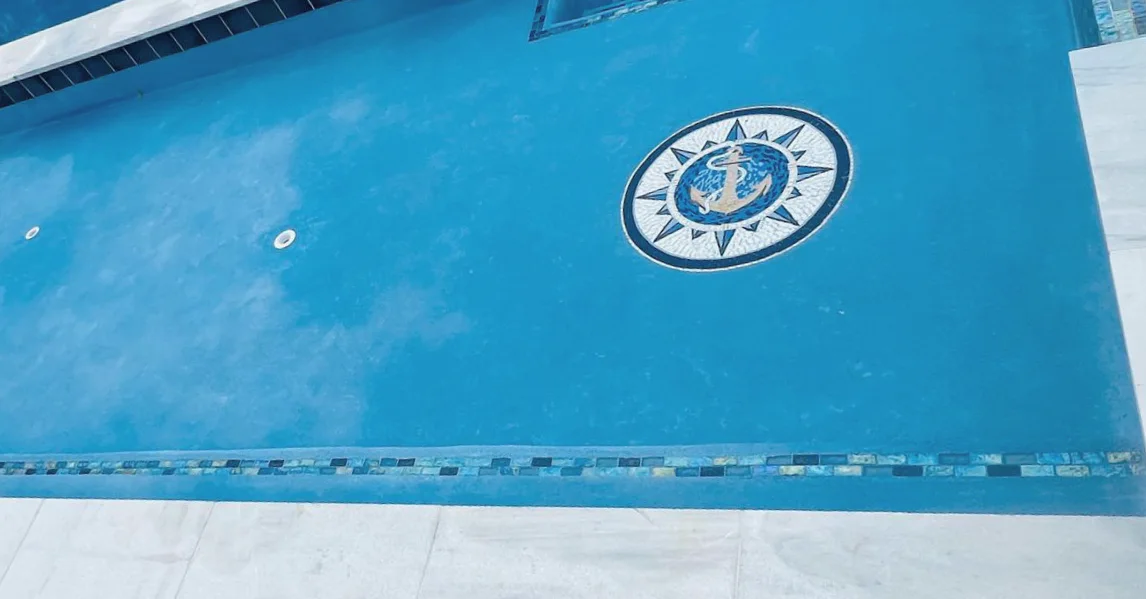
The color of a pool stain is your first clue to its cause. According to the National Plasterers Council (NPC), iron can cause red, orange or black staining, while copper and manganese can cause blue, green or black coloration. Organic stains, from leaves, worms or acorns, are usually green and brown. To confirm, pool chemical maker Natural Chemistry recommends holding a vitamin C tablet on the stain for at least 2 minutes: if it lightens, the stain is most likely metal.
Getting the category right matters more than the product you buy. Metal stains and organic stains need opposite treatments, and a few stains that look like metal are really a structural problem inside the pool shell. Here is how to read the colors, test the stain and choose the fix.
What does each pool stain color mean?
Use this chart as a starting point, then confirm with a test. The last column gives the number worth checking for each one:
| Stain color | Most likely cause | Number to check |
|---|---|---|
| Red, orange or rust-colored | Iron: fill or well water, metal equipment, fertilizer, iron-bearing stone | Metals in fill water above 0.2 ppm: pretreat before filling (PHTA) |
| Blue, green or teal | Copper: corroding heater parts, copper algaecides, mineral systems | Copper no higher than 1.3 ppm (CDC, via PHTA); staining can start lower |
| Black | Copper, manganese or iron | Same metal tests as above |
| Purple, with high stabilizer | Copper cyanurate (copper plus high cyanuric acid) | Cyanuric acid 30 to 50 ppm (NPC ideal) |
| Green or brown, often algae-like | Non-living organic matter: leaves, worms, acorns | After treatment, chlorine back below 5 ppm after 24 hours (Natural Chemistry) |
| Rust spot that returns in the same place | Rebar rusting inside the shell | Concrete cover over steel: most codes require 3 inches against earth (Pool & Spa News) |
| White or gray film or crust | Scale, not a stain | LSI above the NPC’s 0.0 to +0.3 target; a positive LSI causes scaling (NPC) |
Natural Chemistry’s vitamin C test, below, separates metal stains from organic ones; it does not tell you which metal. The Pool & Hot Tub Alliance (PHTA) notes that only a handful of metals typically cause trouble in pool water: iron, copper, manganese and cobalt, plus calcium and magnesium as scale. White scale belongs to a different problem, covered in our guide to removing calcium from pool tile.
How do I know if a pool stain is metal or organic?
Start with the vitamin C tablet. Natural Chemistry’s test is to place it on the stain and leave it for at least 2 minutes. A stain that lightens or disappears is most likely metal; one that does not change is most likely non-living organic material. Natural Chemistry adds that organic stains are usually green and brown and often look like algae.
PHTA’s Recreational Water Quality Committee says telling the two apart is “occasionally challenging,” and suggests three things together: the stain’s history, the water chemistry readings and a spot test with ascorbic or citric acid. It flags one trap. Stains caused by iron bacteria, which are organic, can disappear under ascorbic acid and then return as soon as chlorine is restored.
A water test for metals helps, with one caveat from PHTA: most iron and copper tests measure only the free, dissolved form, so sequestered or oxidized metals may not show up. A low reading in a pool that is already stained does not prove the metal is gone.
Does vitamin C remove pool stains?
For metal stains, it can. PHTA describes removal in three steps: lift the stain off the surface with ascorbic acid (vitamin C), citric acid, oxalic acid or a similar product; tie up the now-dissolved metal with a sequestering agent; then get the metal out of the water. Natural Chemistry’s metal stain procedure for its Stainfree products (the Extra Strength version is 100% ascorbic acid) gives the numbers:
- Balance the water first, with pH between 7.2 and 7.6; the products work best near 7.2.
- Lower chlorine to 1 ppm, because a high chlorine level keeps the treatment from working.
- Add 1 pound per 10,000 gallons as close to the stain as possible, with the pump off overnight, then brush.
- Follow with a sequestrant, and hold off on shocking for at least 1 week if any staining remains.
Follow the label of the product you use. Two cautions apply to every brand. First, PHTA says sequestrants only chelate metals and do not remove them, and the chlorine slowly destroys them, so maintenance doses are needed. The only ways PHTA lists to actually lower dissolved metals are replacing part of the water, reverse osmosis or adsorbent media. Second, PHTA says removing metal stains with muriatic acid should only be done by an experienced pool professional, because permanent damage to the surface can occur.
Organic stains need the opposite approach. Natural Chemistry’s method is to raise chlorine to breakpoint and scrub the area with a brush suited to the surface, then make sure chlorine has dropped back below 5 ppm after 24 hours. Pull the leaves out first.
What causes rust stains in a plaster pool?
Iron is the culprit, and PHTA’s list of the ways metals reach pool water covers its usual routes: fill water (especially well water), metal equipment, lawn and plant fertilizers that blow or wash in, and irrigation systems that use well water or reclaimed water. It also notes that marble, flagstone and granite naturally contain iron and can leach into a pool after every rain.
The local water matters here. The U.S. Geological Survey’s 1990 ground water atlas says the untreated water of the sand-and-gravel aquifer that supplies Baldwin County, Alabama and Escambia and Santa Rosa counties in Florida is usually low in dissolved minerals, but dissolved iron can be locally objectionable, with concentrations as high as 4,300 micrograms per liter reported. If a sprinkler or a top-up hose draws from a private well, test that water for iron before it reaches the pool; PHTA recommends pretreating source water with total metals above 0.2 ppm and avoiding untreated water above 1 ppm.
When the rust comes from inside the shell
A rust spot that keeps reappearing in the same place is a different problem. Pool & Spa News explains that steel properly encased in concrete does not rust, because concrete’s alkalinity protects it. Trouble starts when the gunite or shotcrete did not fully cover the bar, either because material built up on the front of the bars and left voids behind them, or because the finisher cut the shell too thin. That is why rebar stains show up more often in freeform pools and on curves, steps, benches and tight corners. Most codes require 3 inches of concrete between earth and rebar, the magazine notes.
No chemical fixes that. The repair Pool & Spa News describes is to chip out the stained plaster, follow the rust along the bar until clean steel appears on both ends, cut out the rusted section, pack the cavity and patch the plaster. Left alone, it warns, the corrosion spreads and the shell can crack. If the plaster is near the end of its life anyway, the magazine suggests refinishing the pool and dealing with the rebar in the same project. Our pool resurfacing page walks through the resurfacing process, which starts with a site visit and a written estimate.
Can you remove a stain even if it’s been dried?
Usually, as long as it is a true stain and not damage to the surface. Natural Chemistry offers a stronger ascorbic acid product for older stains on floors and walls, so a stain that has sat for months is not automatically permanent. For deeply embedded stains that conventional cleaning cannot remove, HomeGuide describes the acid wash on a drained pool: it strips a very thin layer of plaster, concrete or aggregate surface and takes those stains with it. Because it removes finish every time, it is a professional job and a last resort; our pool acid wash guide covers when it is worth it, and our pool acid wash page covers the service.
Some marks will not wash out because they are not stains. The NPC says that when water stays aggressive, meaning low in calcium, pH or alkalinity, pigment can be leached up to 1/8 inch deep, and that color loss is irreversible. Faded, blotchy or rough areas like that need a new finish, such as quartz pool plaster, not a stronger chemical.
How do you keep stains from coming back?
- Test fill water for metals before filling. The NPC start-up card makes this part of the first day, along with pH, alkalinity and calcium.
- Keep pH from dropping. PHTA calls pH the most overlooked factor: water below pH 7 is likely corrosive and can dissolve metals from filters, heat exchangers and cement surfaces.
- Keep the LSI between 0.0 and +0.3. The NPC says a positive LSI causes mineral scaling and metal staining, and a negative one causes etching and discoloration. Our calcium hardness guide explains how to read it.
- Have the bonding system checked. PHTA recommends testing it at least once a year, because a failed bond lets metal parts corrode into the water.
- Keep leaves, fertilizer and metal out of the pool. Sweep fertilizer granules off the deck and away from the water, and pull leaves before they sit overnight.
If you are in Pensacola, Alabama or the Mississippi Gulf Coast and want a second opinion on your pool, request an estimate.
Sources
- The Most Common Reasons for Loss of Color, National Plasterers Council, accessed November 25, 2026.
- NPC Pool Start-up Card (rev. 03.2021), National Plasterers Council, accessed November 25, 2026.
- Fact Sheet: Metals and Metal Staining, Pool & Hot Tub Alliance, accessed November 25, 2026.
- Staining, Natural Chemistry, accessed November 25, 2026.
- Metal Stain Removal Procedure, Natural Chemistry, accessed November 25, 2026.
- Stainfree Extra Strength, Natural Chemistry, accessed November 25, 2026.
- How to Repair Rebar Stains, Pool & Spa News, accessed November 25, 2026.
- Ground Water Atlas of the United States, HA 730-G (1990): Sand and Gravel Aquifer, U.S. Geological Survey, accessed November 25, 2026.
- How Much Does It Cost to Acid Wash a Pool?, HomeGuide, accessed November 25, 2026.