Coping · · 6 min read
Replacing Pool Coping: Cost, Warning Signs and the Process
Replacing pool coping runs $30 to $80 per linear foot in 2026 national cost guides. See the warning signs, whether to drain, and each step of the job.
By Outdoor Hardscapes Pool Finishes, pool finishing contractor in Pensacola, FL.
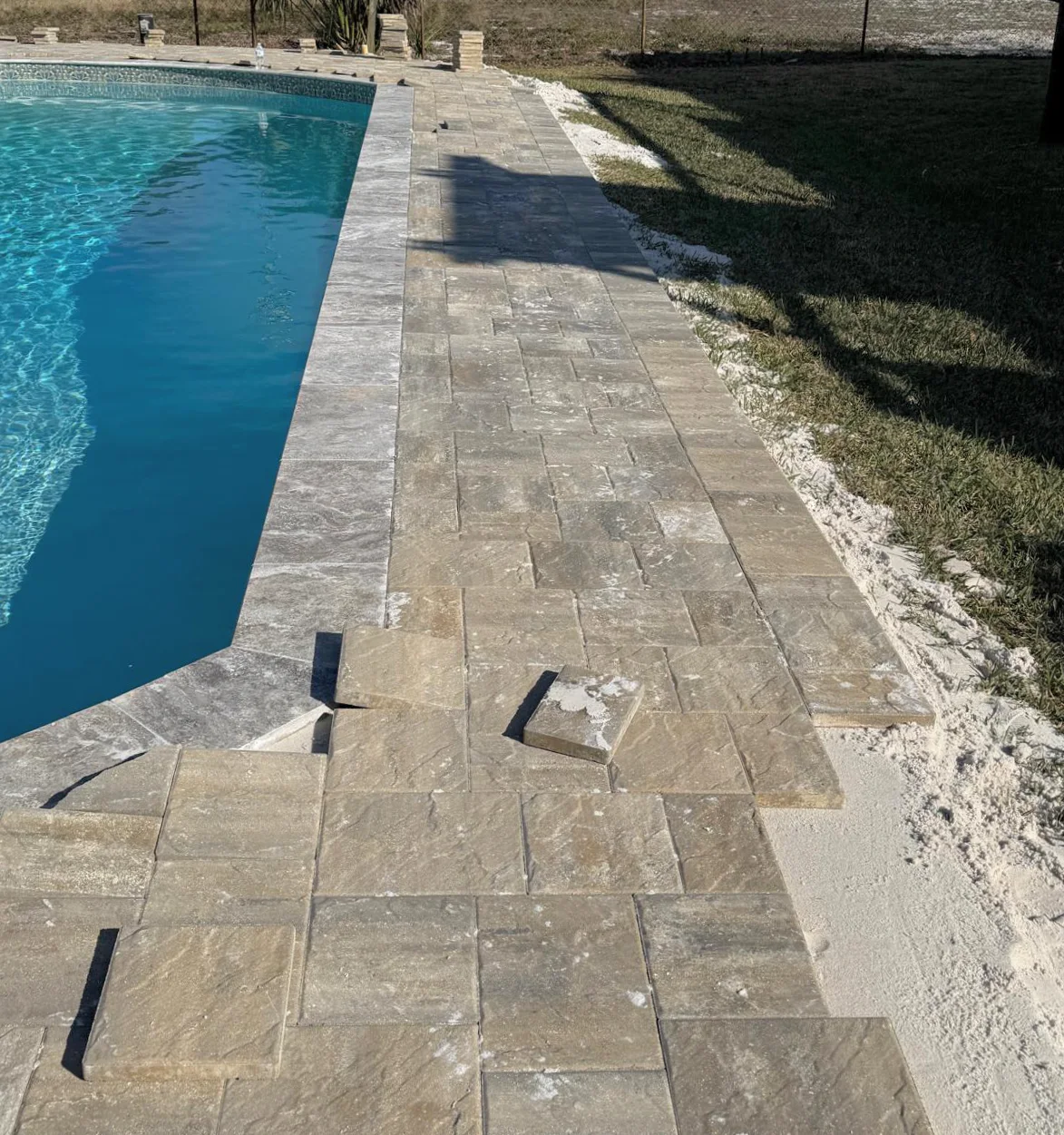
Yes, inground pool coping can be replaced, and on most pools it is done without draining: Angi’s guide to tile and coping replacement says to lower the water below the tile line before starting. National cost guides put the work at $30 to $50 per linear foot (Angi, updated September 2026) up to $40 to $80 per linear foot installed (HomeGuide, January 2026). For the 96 feet of coping around a 16 by 32 foot pool, our arithmetic on those two ranges gives roughly $2,900 to $7,700, a national reference, not a quote.
The rest of this guide covers how to tell when coping is failing, how the job is done and what drives the price.
What are the common problems with pool coping?
Coping fails in a few predictable ways. Walk the edge of your pool and look for these:
- Loose or rocking pieces. The mortar bed under the piece has let go. Left alone, water gets under it and the loose area spreads.
- A hollow sound when you tap a piece. The bond underneath is failing even if the piece has not moved yet.
- Cracked, chipped or broken stone or brick. Often caused by movement, impact or a piece that was never fully supported.
- An open, cracked or hardened joint between the coping and the deck. This joint is meant to stay flexible. The 2024 International Swimming Pool and Spa Code (ISPSC) says joints where coping meets a concrete deck must protect the coping and its mortar bed from the movement of the deck. The ISPSC is a model code that applies only where your state or local government has adopted it, so confirm the local rules with your building department.
- Cracked or loose waterline tile under the coping. Angi notes that a neglected expansion joint damages the coping, “which in turn will damage your tile.”
- Pitting, flaking or heavy staining on stone. Porous stone around a salt water pool deserves a close look, which is why Hayward’s salt cell instructions tell owners to consult a stone installation specialist about stone type, sealant and maintenance.
If you see one loose piece, it may be a simple reset. If you see several of these signs at once, it is time to look at the whole edge.
Should you repair or replace pool coping?
A repair, or reset, fits when only a few pieces are loose and the material itself is sound. The pieces come up, the old mortar is cleaned off, and they go back down in fresh mortar.
Full replacement makes more sense when:
- Loose or hollow pieces run around much of the pool.
- The material is cracked, flaking or worn smooth and slippery.
- The top of the pool wall, called the bond beam, needs repair. HomeGuide notes that bond beam work adds cost before new coping can go on.
- You are already renovating, with a new interior finish or tile planned, and want the edge to match.
- You want a different material, for example brick to travertine. Our comparison of pool coping materials covers cost, heat and upkeep for each option.
Can you replace pool coping without draining the pool?
Usually, yes. Coping sits above the waterline, so the water only needs to come down below the tile line, as Angi describes, to keep the work area, the mortar and the tile dry. A full drain is only needed when the job also includes work below that level, such as a new interior finish.
Emptying a pool completely is its own decision with its own risks. We cover that in draining a pool for resurfacing. If coping, tile and resurfacing are all on your list, doing them in one pool renovation avoids lowering the water more than once.
What is the average cost to replace pool coping?
Two national guides frame the range. Angi’s 2026 pool remodel guide lists coping replacement at $30 to $50 per linear foot. HomeGuide’s 2026 coping guide lists installed coping at $40 to $80 per linear foot and notes that replacing existing coping costs more than installing new. Coping is priced by the linear foot, so the length of your pool edge drives the total.
| Pool example | Coping length | Angi range ($30 to $50 per ft) | HomeGuide range ($40 to $80 per ft) |
|---|---|---|---|
| Small plunge pool | 40 ft | $1,200 to $2,000 | $1,600 to $3,200 |
| 16 x 32 ft rectangle | 96 ft | $2,880 to $4,800 | $3,840 to $7,680 |
| 20 x 40 ft rectangle | 120 ft | $3,600 to $6,000 | $4,800 to $9,600 |
| Large freeform pool | 150 ft | $4,500 to $7,500 | $6,000 to $12,000 |
The 40 foot and 150 foot lengths are HomeGuide’s own examples of a small plunge pool and a large freeform pool. The rectangle lengths are simple perimeter math, so 2 x (16 + 32) = 96 feet, and each cost cell is the length multiplied by the guide’s per-foot range. Curves, steps, a spa, bond beam repairs and the material you choose all move the number. These are national reference ranges, not our prices. The real number for your pool comes from a site visit and a written estimate.
How is pool coping replaced, step by step?
Here is how a typical coping replacement on a concrete pool runs:
- Inspect and measure. The crew measures the linear feet, checks the bond beam, the waterline tile and the deck joint, and confirms whether any deck pieces along the edge must come up too.
- Lower the water. Bring it below the tile line so the work area stays dry.
- Remove the old coping and mortar. Pieces come off with chisels and pry bars, and the loose mortar is chipped away. Care here protects the tile band right below.
- Repair the bond beam if needed. New coping is only as good as the concrete it sits on.
- Set the new coping. Each piece goes into fresh pool mortar, aligned with its neighbors and sloped slightly away from the pool, as Angi describes, so splash water runs to the deck rather than back over the edge.
- Grout the joints between pieces.
- Seal the coping-to-deck joint with a flexible sealant, not mortar. The ISPSC requires the isolation joint where coping meets a concrete deck to be watertight. Joint sealant makers set rules for it: W. R. Meadows, for its Deck-O-Seal 125, calls for a 2:1 width-to-depth ratio and a sealant depth between 1/4 and 1/2 inch, and lists backer rod and foam joint fillers among the backing materials that control sealant depth.
- Let the mortar cure. Follow the mortar maker’s cure time before the water goes back up.
- Seal porous stone. On a salt water pool, timing matters. The LATICRETE data sheet for its salt water resistant sealer says it is not intended for surfaces already exposed to salt water and rates its expected wear at up to 5 years around salt water pools, so the stone should be sealed before salty water reaches it.
- Refill and rebalance the water.
On any pool coping job, the deck joint and sealing steps deserve the same attention as setting the stone, because they decide how long the new edge lasts.
Should you replace the waterline tile at the same time?
Often it is worth considering. The tile band sits directly under the coping, so removing old coping can disturb it, and tile replacement needs the water lowered too. If your tile is old, stained or loose, replacing both in one visit means one water drawdown, one cleanup and a matching edge. Our pool tile work covers porcelain and glass waterline tile, and our guide to replacing pool tile explains that job in detail. If an interior refinish is coming within a few years, it can make sense to pair it with pool resurfacing so the edge and the finish are done together.
If you are in Pensacola, Alabama or the Mississippi Gulf Coast and want a second opinion on your pool, request an estimate.
Sources
- How Much Does Pool Coping Cost? (2026), HomeGuide, accessed November 25, 2026.
- How Much Does a Pool Remodel Cost? (2026 Data), Angi, accessed November 25, 2026.
- How to DIY Pool Tile and Coping Replacement, Angi, accessed November 25, 2026.
- 2024 International Swimming Pool and Spa Code, Chapter 3: General Compliance, International Code Council, accessed November 25, 2026.
- Deck-O-Seal 125 Two-Part Pourable Joint Sealant, W. R. Meadows, accessed November 25, 2026.
- STONETECH Salt Water Resistant Sealer Data Sheet (DS-288), LATICRETE, accessed November 25, 2026.
- Turbo Cell Instructions and Limited Warranty (092006E Rev B), Hayward, accessed November 25, 2026.