Resurfacing · · 7 min read
Draining a Pool for Resurfacing and the Hydrostatic Relief Valve
A pool must be drained to resurface it, but groundwater can float an empty shell. How hydrostatic relief valves work, why pools pop and the hurricane rule.
By Outdoor Hardscapes Pool Finishes, pool finishing contractor in Pensacola, FL.
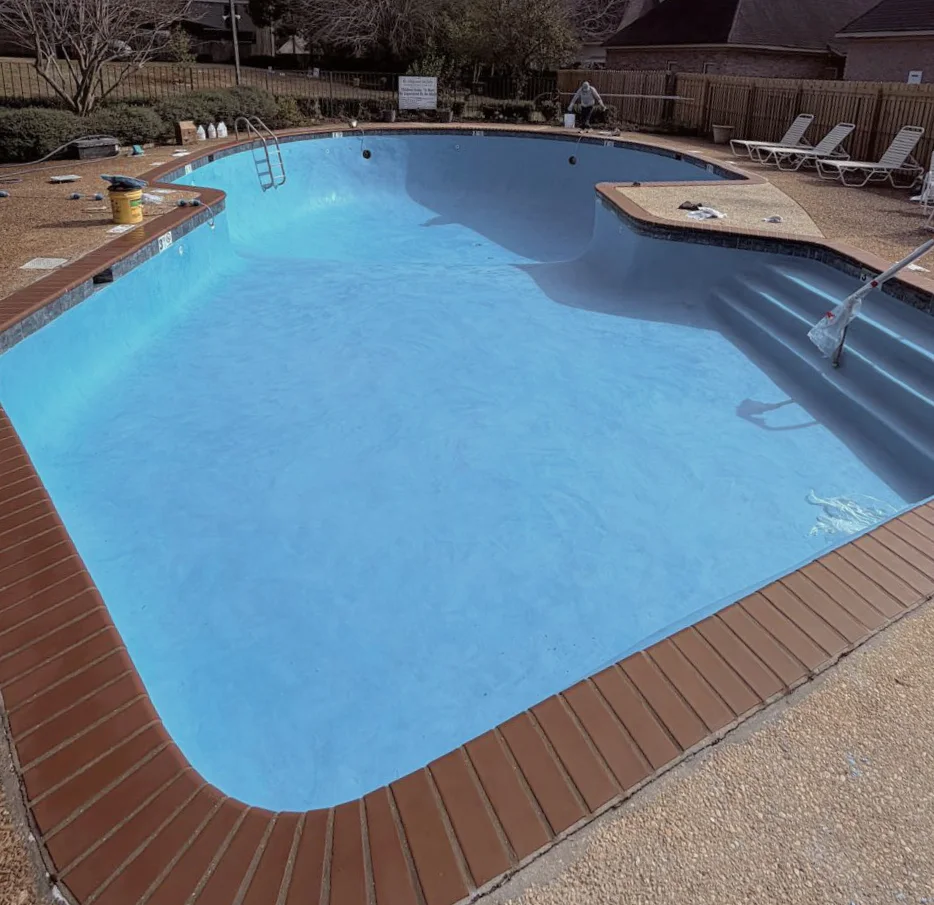
Yes, a concrete pool has to be drained to be resurfaced, and on the Gulf Coast the drain itself carries a real risk. A 1984 U.S. Geological Survey report says that in valleys and low-lying coastal areas of extreme northwestern Florida the water table is generally within 10 feet of the land surface, and groundwater pushing up on an empty shell can float it out of the ground. A hydrostatic relief valve in the pool floor lets that water in to relieve the pressure, which is why the 2023 Florida Building Code requires one in areas of anticipated water table.
Here is how the valve works, why pools still pop, why you never drain before a hurricane, and why the draining belongs to a professional.
Do you have to drain a pool to resurface it?
Yes. A new finish is applied by hand to a drained, cleaned and prepared shell, and an acid wash is also done on a drained pool. The risk is not the pumping itself but what happens while the shell sits empty.
The National Plasterers Council (NPC) says pool finishes are designed to stay wet, and that there is no single safe timeframe. Hot, dry or windy weather speeds up drying damage, and finishes that are still curing are the most sensitive. Its advice is careful planning, a crew ready to work and a quick fill. UF/IFAS Extension adds that when rain saturates the ground, the water outside even a partly drained pool can crack it.
What does a hydrostatic relief valve do?
It is a one-way check valve, often placed in the main drain line on the pool floor. PE Group (PEGroup Consulting Engineers), a Florida structural and forensic engineering firm, explains that the valve exists to equalize the pressure between the groundwater under the pool and the water in it. When the pressure beneath the pool gets higher than the pressure inside, the valve opens and lets groundwater flow into the pool instead of lifting the shell. A murky cloud near the main drain can be a sign that the valve recently opened.
Florida writes this into code. Section R4501.21.4 of the 2023 Florida Building Code, Residential, says that in areas of anticipated water table, an approved hydrostatic relief device shall be installed, with an exception for plastic liner pools. AQUA Magazine, a pool trade publication, describes the valve as an inexpensive insurance policy that, as a general statement, every pool should have.
Before any drain, the NPC says to verify that a hydrostatic valve is in place.
Can a pool pop out of the ground?
Yes. PE Group says that when soil is saturated, the upward force of groundwater can overcome the weight of an empty or partly empty pool and the friction of the soil on its walls, and the pool moves up. The firm says this “pool popping” happens every year somewhere in Florida, mostly during the rainy season, and that the damage is often worst at the deep end. Concrete walls are typically 4 to 6 inches thick and reinforced with steel, yet PE Group notes concrete pools are still susceptible.
The force adds up fast. Each foot of groundwater above the pool floor pushes up with the weight of a foot of water on every square foot:
| Groundwater above the empty pool floor | Upward pressure on the floor | Total push on a 15 x 30 ft floor |
|---|---|---|
| 1 foot | 62 lb per sq ft | about 28,000 lb |
| 2 feet | 125 lb per sq ft | about 56,000 lb |
| 4 feet | 249 lb per sq ft | about 112,000 lb |
| 6 feet | 374 lb per sq ft | about 168,000 lb |
Our own arithmetic, for illustration only, using the U.S. Geological Survey figure of about 62.3 pounds per cubic foot for water at 70°F. Real uplift depends on the shell’s outside dimensions, its own weight and soil friction, so this is not an engineering check; a specific pool needs a professional’s evaluation.
For scale, the water in a full 15 x 30 ft pool that averages 5 feet deep, about 16,800 gallons, weighs roughly 140,000 pounds. When that water is pumped out, only the shell’s own weight and the soil around it hold the pool down.
A valve is not a guarantee. Geotechnical engineer Neil Anderson told AQUA Magazine that he has seen pools with hydrostatic relief valves pop anyway, because a valve stopped working or let water into the pool more slowly than water was flowing into the area around it. He recalled a pool whose builder had left two holes in its floor that still lifted during a rain. PE Group lists two valve problems of its own: a valve stuck open, or one that fails to open.
If a pool does lift, PE Group says not to refill it, because refilling will likely crack it further, and to have a structural engineer assess it first.
Is it safe to drain an inground pool?
It is when someone who does it for a living plans it. The Florida Swimming Pool Association (FSPA) says that if you must drain your pool, seek professional advice to prevent damage, and PE Group says an experienced pool maintenance contractor should be consulted before an inground pool is emptied. We recommend leaving the drain to the professional doing the work. These are the things that professional should be checking:
- Rain. Not during or right after heavy rain, when the ground is saturated, and not with heavy rain in the forecast.
- The valve and the groundwater. Confirm the pool has a working hydrostatic relief valve and get a sense of how high the groundwater is. On wet sites, PE Group describes well points, pipes set in sand or gravel beside or under the pool, that draw groundwater down before the pool is emptied.
- Where the water goes. Pump it well away from the pool. In the same AQUA article, Anderson describes rainwater that gathered where a construction ramp had been, soaked in around a pool built without a relief valve and popped the shell even though there was no high water table.
- Time empty. The shorter the better: the crew and materials should be ready before the water goes.
- Equipment. UF/IFAS warns that a pool drained below the skimmer can burn up the pump motor, so whoever drains the pool should also take care of the pool equipment.
Should I drain my pool before a hurricane?
No. The FSPA’s hurricane checklist says it plainly: keep it full. The weight of the water keeps the pool from being lifted off its foundation and popping out of the ground under pressure from Florida’s high water table. UF/IFAS Extension says not to drain, or even partially drain, a pool before a storm, and notes that a pool is made to hold water and can handle being filled to overflowing.
After the storm, the FSPA says you can drain rainwater down to the pool’s regular level, and UF/IFAS suggests waiting until the surrounding landscape has had time to drain. The FSPA notes that hurricane season runs from June 1 to November 30, so a resurfacing drain should never be scheduled with a tropical system in the forecast.
Why is draining riskier on the Gulf Coast?
Groundwater sits close to the surface here. The 1984 USGS study behind the 10-foot figure covers the sand-and-gravel aquifer of extreme northwestern Florida, the aquifer that supplies Escambia and Santa Rosa counties, and it notes that the aquifer lies right at the land surface. Add Florida’s rainy season, when PE Group says most pool pops happen, and the FSPA’s own warning about “Florida’s high water table,” and the margin for error is small. Coastal Alabama and Mississippi pools deserve the same caution, even where local code differs.
On a pool resurfacing job, the drain belongs in the plan from the start, so the shell sits empty as briefly as possible. Our pool resurfacing cost guide explains what goes into the estimate, including draining and refilling.
What happens after the new finish goes on?
The NPC calls for a quick fill once the work is done, and a new plaster finish then needs a 28-day startup of brushing and water balancing. Our guide to new pool plaster startup covers it day by day.
If you are in Pensacola, Alabama or the Mississippi Gulf Coast and want a second opinion on your pool, request an estimate.
Sources
- Phenolic Contamination in the Sand-and-Gravel Aquifer (WRI 84-4230), U.S. Geological Survey, accessed November 25, 2026.
- Tech Bulletin: Swimming Pool Failure (June 2013), PEGroup Consulting Engineers, accessed November 25, 2026.
- Pressure Points, AQUA Magazine, accessed November 25, 2026.
- Chapter 45 Private Swimming Pools, 2023 Florida Building Code, Residential, International Code Council, accessed November 25, 2026.
- Hurricane Preparedness, Florida Swimming Pool Association, accessed November 25, 2026.
- Pools and Hurricanes, UF/IFAS Extension Indian River County, accessed November 25, 2026.
- Frequently Asked Questions (previously published NPC guidance), National Plasterers Council, accessed November 25, 2026.
- Water Density, U.S. Geological Survey Water Science School, accessed November 25, 2026.